
Best of Beijing – A 3-day Beijing Itinerary
China’s capital city is a huge, sprawling metropolis but it still embraces and celebrates the country’s long and fascinating history. Our 3-day Beijing itinerary will ensure you see the essential sights of this remarkable city, so many of which are UNESCO listed. We also have some suggestions for things to do in the evenings.
Please note that this post contains affiliate links. If you click through and decide to make a purchase we will make a small commission, at no extra cost to you, which will help towards the costs of running this site.
When To Visit Beijing
Beijing can be visited all year round, although some times will be busier than others. Lunar New Year, also known as Spring Festival, will be very busy for travelling around China. Also, the first week in October is National Week holiday, so transportation is likely to be busy then as well. We travelled in the winter – just after the main New Year celebration but towards the end of the Spring Festival fortnight. New Year is a lunar event and its timing will vary from year to year. The first day falls on the second new moon after the winter solstice, usually between 21st January and 20th February.
Travelling in winter was fantastic because the attractions were less crowded. Also, at the time of our visit, the air pollution wasn’t too bad (and Beijing is notorious for its poor air quality). But it was very cold so we recommend wrapping up warmly.
3-Day Beijing Itinerary – Day 1
Summer Palace and Hutong Alleys
Take the metro or a bus to the Summer Palace, a gorgeous landscaped garden and park that is a UNESCO heritage site. It was constructed as an imperial garden during the Qing Dynasty and completed in 1764.
The garden is formed around Kunming Lake and Longevity Hill. Although the vast lake looks natural it is completely artificial.
Highlights include the Tower of Buddhist Incense at Longevity Hill, a beautiful octagonal structure used as a place of prayer for the emperors and empresses.

The Seventeen Arch Bridge links to Nanhu Island. It’s the largest bridge in the palace grounds and is highly decorated, notably with beautiful carved lions.

The Long Corridor is 728m long and dates from the 18th century. It is a beautifully decorated covered walkway with artwork inspired by literature, folk stories, legendary heroes, historic figures, enhanced by intricate images of flora and fauna.

The Summer Palace is located around 15km from the city centre. You can take Line 4 to Beigongmen Station or a bus to Xin Jian Gong Men (Yiheyuan New Palace Gate).
Return to Beijing and spend the afternoon exploring the hutongs. These give a real insight into old Beijing. Dating back to the 13th century, they comprise a maze of winding alleyways behind which are single-storey houses set within courtyards. It’s possible to take a rickshaw ride through these areas. Some houses are open to the public so that you can peep inside and get to understand local life. Although modern architecture dominates the city a fair few hutongs remain and you can choose which you wish to visit.

3-Day Beijing Itinerary Day 2 – Great Wall of China
No trip to Beijing would be complete without visiting the Great Wall of China. One of the seven wonders of the modern world, this UNESCO heritage site is a triumph of engineering. The wall runs almost 20,000km from Gansu to southern Manchuria and was built over many centuries by successive Chinese emperors. It’s a myth that the construction can be seen from space, but who cares? It’s still unbelievably impressive.

The most popular sections of the wall that are easily accessible from Beijing are at Mutianyu and Badaling. We visited Mutianyu, which is about 45km away from the city. It takes an hour or two to reach it depending on the traffic (which can be congested in Beijing). You can catch a bus, get a taxi or go on an organised day trip. These days, the numbers of visitors are restricted to 30,000 each day, so pre-booking is essential.

At Mutianyu you ascend to the wall by cable car and can then walk along it. The views are nothing short of spectacular as you view it snaking across the undulating mountains as far as the eye can see.

When you’ve finished admiring the sheer magnificence of this amazing structure, you descend again by cable car. Or, if you’re feeling adventurous, you can take a slide to the bottom.
3-Day Beijing Itinerary Day 3
Tiananmen Square and The Forbidden City
Slap bang in the heart of Beijing is Tianenamen Square, Square of the Gate of Heavenly Peace. It is one of the largest public squares in the world. Tiananmen Square is big. Really big. Big enough to fit 1,000,000 people.

To those outside China the square is best known for the student democracy protests that ended with a catastrophic military intervention and massacre in 1989. Although the world was watching, many people within China are still unaware of what happened. There are often several plainclothes security officers in the square.
You can reach the square on Subway Line 1 – Tiananmen East or Tiananmen West. Entrance is free but there are fixed entrance locations. Security checks will take place, bags will be searched and we advise keeping your documentation with you. It is really important not to talk about the events of 1989 while visiting the square. We also recommend not wearing clothes that have political messages.
There are various monuments around the square, including the Monument to People’s Heroes and the Monument to Revolutionary Struggle at Mao Zedong’s mausoleum.


The China National Museum, which exhibits precious cultural artefacts, lies to the east of Tiananmen Square and the Great Hall of the People is on the western side.
To the north of the square is the Forbidden City.

This enormous complex is the former imperial palace of Chinese Emperors, from the Yongle Emperor of the Ming dynasty until the end of the Qing Dynasty. Constructed between 1406 and 1420, it boasts 9,999 rooms (although they have since been counted and the total came to 8,886, which is still pretty impressive). It has a rectangular form, nearly 970m long on a north-south orientation and 750m wide.

Even though the site is huge, visitor numbers are now restricted to 40,000 per day so we recommend prebooking tickets for your visit.

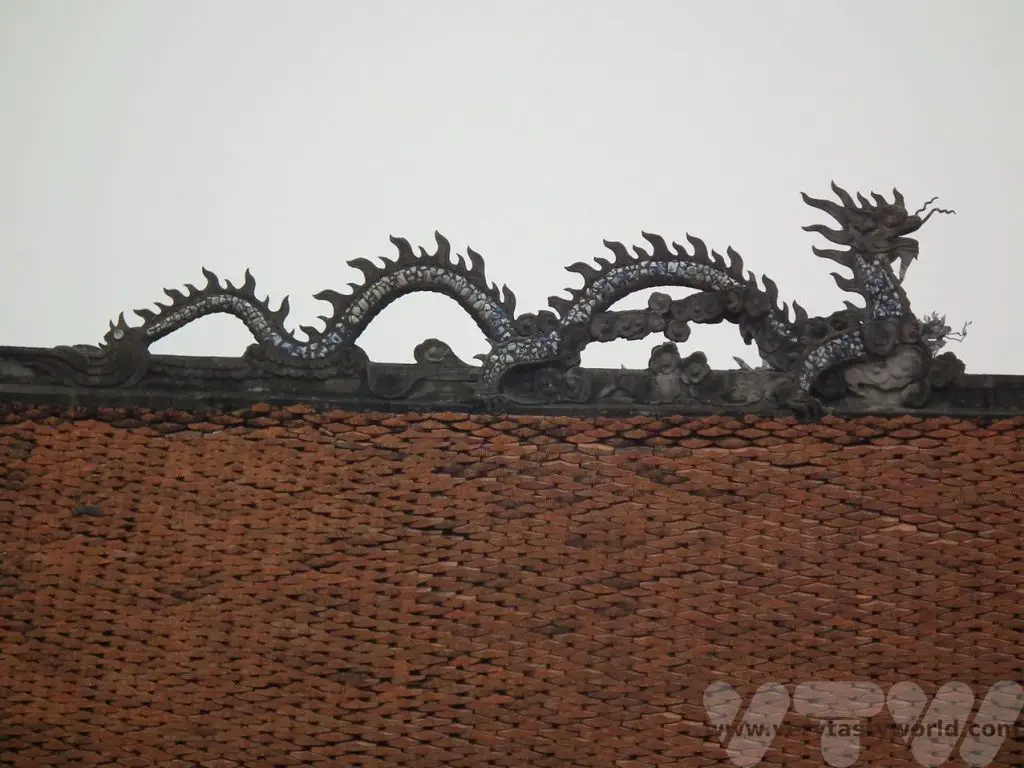
The details in the architecture are remarkable. Many of the rooftops have a series of animals striding across them. Each animal represents something different – lions stand for power, dragons protect against fire and the phoenix should bring good fortune. The quantity of animals indicates the status of the building – the most important will have nine.

Many of the the gate entrances are protected by guardian lions – the male lion places his left paw on an orb and the female places hers on her cub.

And the imperial garden has lovely pavilions.

The Temple of Heaven
In the afternoon we recommend a visit to the delightful Temple of Heaven complex. The purpose of the beautiful buildings, set within a lovely garden, was for the Emperor to pray for good harvests. From the Forbidden City/Tiananmen Square, Line 1 then Line 5 to Tiantan Dongmen Station, Exit A, will get you to the East gate.
The Circular Mound Altar comprises three beautiful terraces, built for the Emperor to pray for good weather.

The Imperial Vault of Heaven was the repository for the tablets of the gods, used when making prayers.

The Hall of Prayer for Good Harvests which, as the name suggests, was a place of prayer as the emperor would ask the gods for bountiful yields of food.

There are tea houses close by and this is a great opportunity to learn about Chinese teas and to have a taste. We have a post with more detail about the Temple of Heaven and tasting heavenly tea. Although beware, there are sometimes scams surrounding tea houses where a friendly local person may approach you and invite you to drink tea with them and they can practice their English. But then they disappear and you end up with a very expensive bill. Most establishments are absolutely respectable, but always check the menu and pricing!
Suggestions for Evening Entertainment
Visit A Food Street Or Night Market.
Wangfujing Food Market is one of the largest and most famous in Beijing. Located close to the Forbidden City, there are all sorts of delicacies on offer, including some that could be a challenge! Bugs and scorpions, anyone? Or maybe some wiggly seafood?


Guijie Night Market, in Dongzhimen, is open 24 hours and offers a huge range of traditional Chinese delicacies.
See An Acrobatics Show
Chinese acrobats are jaw-droppingly skilled. For a spectacular evening of thrills, we recommend an acrobatic show. From balancing acts to juggling to contortion to multiple crazy motorcycles zooming inside spherical cages (which had us on the edge of our seats) you are sure to be entertained.
Watch A Beijing Opera Performance
It has to be said that Beijing Opera can be a little challenging to the inexperienced ear. However, there is no doubt as to the skill of the performers, who can sing, dance, stage fight with weapons and perform amazing acrobatics. The costumes and make-up are flamboyant and the performance is highly stylised. This really does represent the best of traditional Chinese entertainment.
Beijing for Foodies
Beijing’s most famous dish is, of course, Beijing Duck (formerly known as Peking Duck). Most Chinese restaurants in the UK when we were growing up were actually Cantonese (Hong Kong) and hence the aromatic crispy duck we ate when growing up is very different to authentic Beijing Duck. Beijing duck’s skin is crispy-thin, almost glassy, and a bronzed orange in colour. It has been a popular dish for many centuries and was one of the dishes that had a predominant place on imperial menus.
A great deal of preparation goes into this dish. After the duck has been plucked and entrails removed, air is pumped under the skin to separate the skin from the fat. The skin becomes tightened when the duck is blanched in boiling water. A marinade comprising honey, soy sauce and five spice is applied and the duck left to hang for at least 24 hours. Then it is roasted in an oven. It is usually served in pancakes with juliennes of cucumber and spring onion. We most definitely recommend trying Beijing duck in Beijing.
Beijing has so much to offer the visitor, from the history spanning millennia to the high-tech modern cityscapes. This three day Beijing itinerary will ensure you see the very best that the city has to offer.
Related Posts You May Enjoy



I enjoyed this itinerary. I would enjoy visiting all the places mentioned. The Summer Palace is extraordinarily beautiful with its gorgeous architecture and gardens. I know I would especially enjoy wandering through the hutongs.
I liked reading that the number of visitors to the Great Wall and the Forbidden City are restricted — I support measures to protect historic sites from over-tourism. You also included great advice about keeping your documents handy and being discrete/apolitical. It’s important to remember our role as guest when visiting other countries.
While Chinese opera is not my cup of tea, I agree that the spectacle and costumes are fantastic.
I would use this post as a reference in planning my visit to Beijing.
Lyn | http://www.ramblynjazz.com
I appreciated your honesty about Tienanmen Square, and it’s interesting how China’s citizens still really don’t know what happened, and while China has it open to the public, and it’s historical significance as a moment where students stood up to their government, is completely zapped away as you have to be careful not to express yourself in an area that almost begs for it. I remember that event very well, as I was a young boy watching on TV and at that age, I was horrified about what happened (and still am). The Great Wall looks impressive, especially with how it’s held up over time. I agree with Lyn on the capping of the number of visitors, you pointed this out in your article on Machu Picchu and I think Covid opened the eyes of the management of a lot of these very popular destinations where too many visitors can dilute the experience of everyone – especially with social media, and the need to get that great picture or video. I hope this trend stays with the most popular spots, though! Great post and photos.
Ah this post brought me back! Beijing was such a magical city with something new at every corner to explore. I’m really glad they’re working to prevent over tourism. I would hate to see their historical buildings overrun with tourists. I wish I got to go to the opera when visiting. Beautiful pics!
Once again a very detailed and comprehensive itinerary guide with many cool activities and popular attractions. I am intrigued to hear more tho! I am particularly interested in how tourist friendly China is. I have heard a couple of mixed opinions from hospitality is unmatched to xenophobia ect I would also like to know more about the visit to the Forbidden City. Do you know if you can book online or do you have to be there in person? It’s one of those do not miss sites when visiting China, not just for his significant historical context but also for its architectural value. It is one of the first sites which are earthquake proven and uses a technology that allows the constructions to wiggle with the earth’s vibrations.
Carolin | Solo Travel Story
Oh Beijing, one of my favorite cities. Your post brings back so many memories of my years in China. It’s hard to get over the enormity of the Forbidden City, but one of the things I loved was visiting Jingshan Park behind it for a view over the palace. I miss the street food there, maybe not the crunchy crawly delicacies, but the flavorful local food that can beat any Chinese restaurant here. Lovely guide, and you’re making me want to book a trip back right now
Beijing has always fascinated me from a historical point of view, especially Tiananmen Square and the Forbidden City… memories of the latter remain with me from the movie “The Last Emperor”.
I don’t know if I’d have the courage to try the food at the night market, as it’s way out of my comfort zone 🙂
The Great Wall is one of the monumental constructions of Humanity that I really want to visit.
Once again, an excellent itinerary, well structured and with appealing and feasible suggestions.