
A Walk Around Alderney
Alderney is a tiny island in the English Channel. It’s a fantastic place to visit for a quiet and relaxing break and also has some amazing beaches if you are looking for some time at the seaside. One of the loveliest things you can do when visiting Alderney is to walk all the way around it. There are plenty of good footpaths and, although it can be a bit hilly in places, it’s an easy walk that affords the most splendid views all the way around with some interesting local legends. Here’s our guide to a walk around Alderney.
Where is Alderney?
Alderney is the third largest, or indeed, third smallest of the populated Channel Islands, an archipelago in the English Channel, which are closer to the coast of France than to England, and a crown dependency of the UK. It is really small – it has an area of about 8 square km, and a population of just 2000 people.
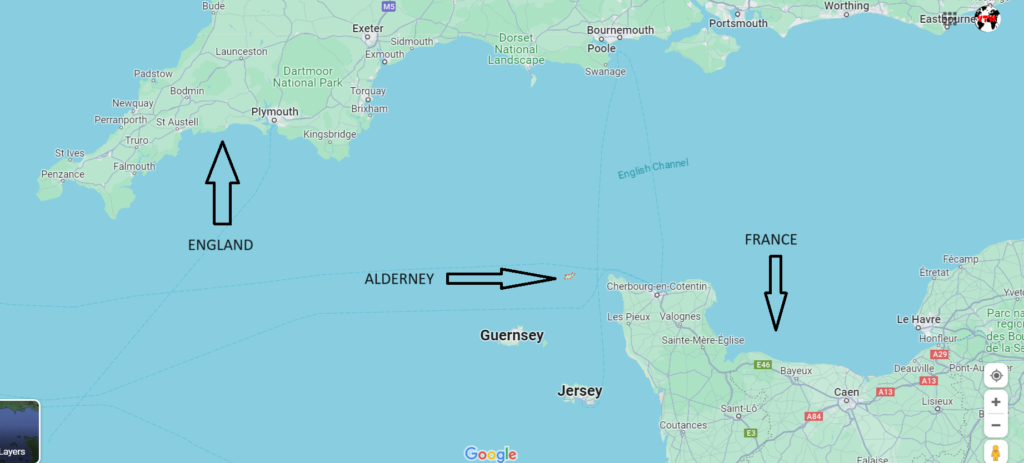
How To Get To Alderney
Alderney isn’t the easiest of places to reach but it’s most definitely worth it when you get there. There are direct flights on the local airline, Aurigny, from Southampton Airport, or you can travel in from other UK airports via Guernsey.
There is also a daily ferry service to Alderney from Guernsey.
Condor Ferries also travel to Guernsey from both the UK and France and you can fly or catch the ferry from there.
If you fly in direct, the flight itself is an adventure as you will be travelling on a tiny plane – because it needs to land on a tiny runway. The 19 seater Dorniers ensure that you will get a good view as you fly out to the island and you will almost certainly be able to see the pilot. One year we flew out for Christmas, and the pilot passed around a box of biscuits for all the passengers to enjoy! Just hope the wind isn’t blowing too hard as it sometimes gets a bit bumpy.
A Walk Around Alderney
Walking around Alderney is an absolute delight. As well as its stunning coastline, from sandy beaches to towering cliffs, Alderney also has a large number of fortifications which have been used to defend this little island over the centuries.
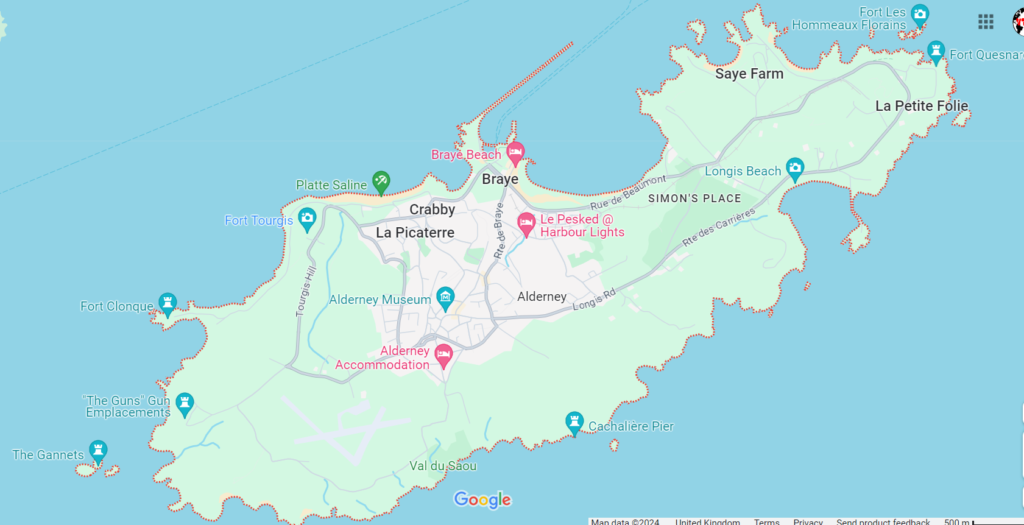
Braye is the obvious place to start a walk around the island. If you are staying in the pretty town of St Anne, let gravity guide you down to the beach along the main road, passing the railway station. Braye Bay is the largest bay on the island and is characterised by its breakwater, a construction that stretches about 1400m into the sea, shielding the harbour and beach from the treacherous currents of the Swinge tidal race.
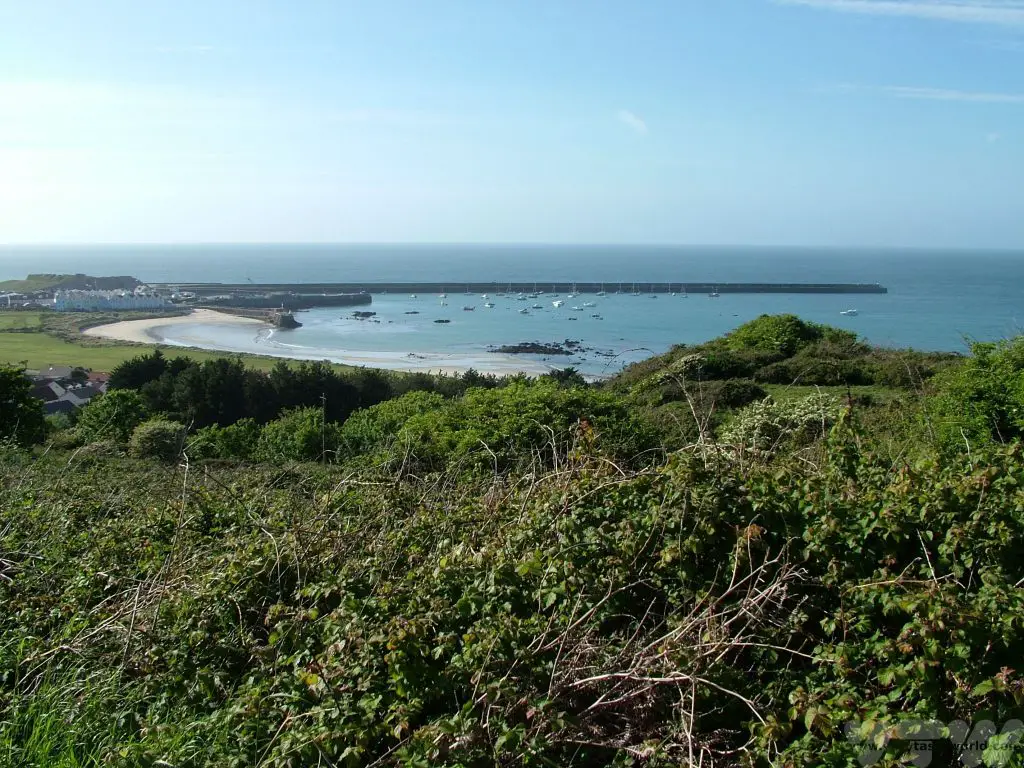
Braye is a beach with a broad sandy area on the western shore and rockpools to explore at the eastern end. It’s possible to walk the length of the breakwater but make sure the weather is fine – it is dangerous to do so on a windy day as waves do crash over it. It can be spectacular during a storm.
On an anti-clockwise tour, walking west, past the inner harbour and electricity generator station, lies the tiny rocky inlet Crabby Bay before the coastline stretches to the sand flats of Platte Saline. Despite its inviting appearance, the tidal currents are swift and it is not safe to bathe on this beach.
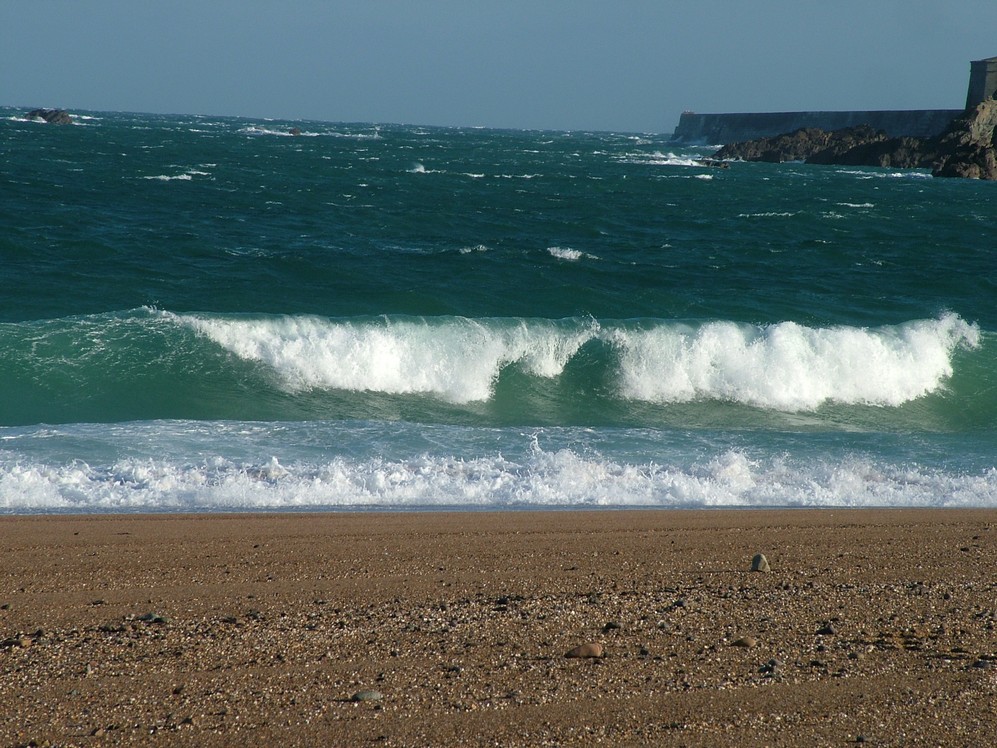
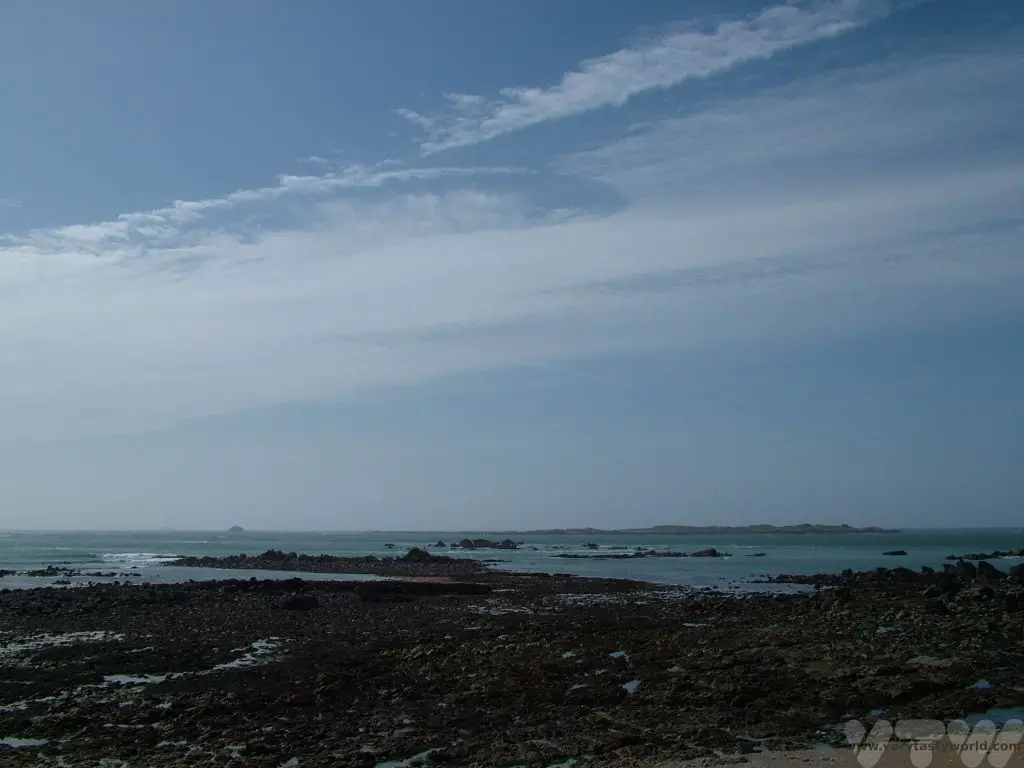
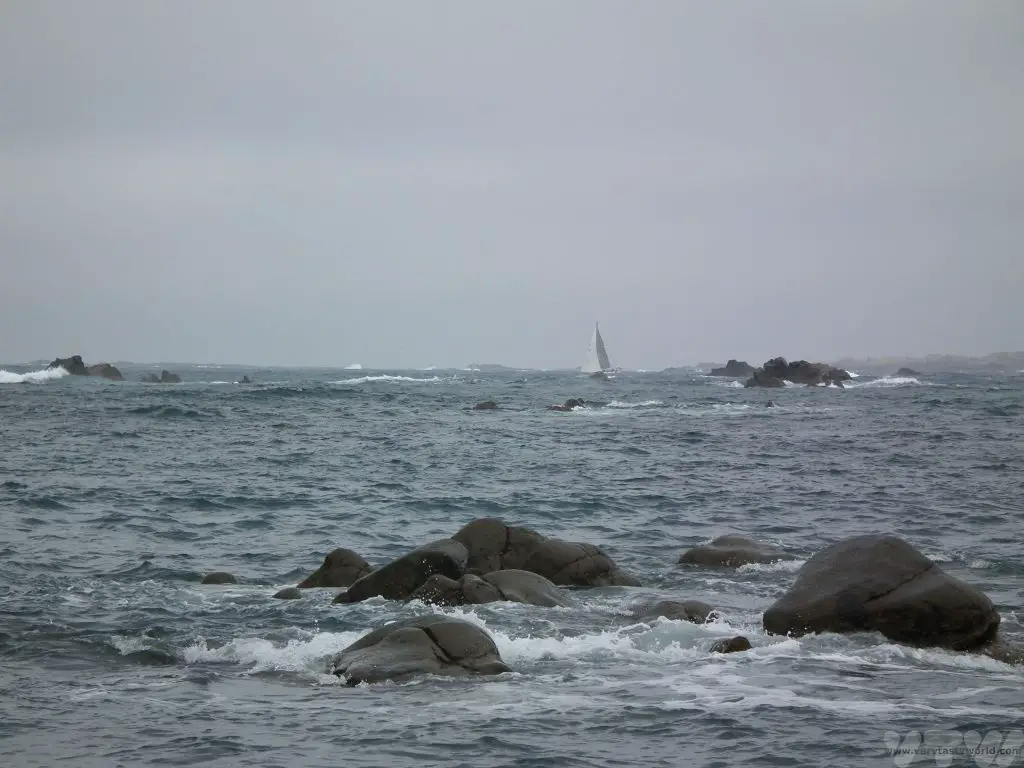
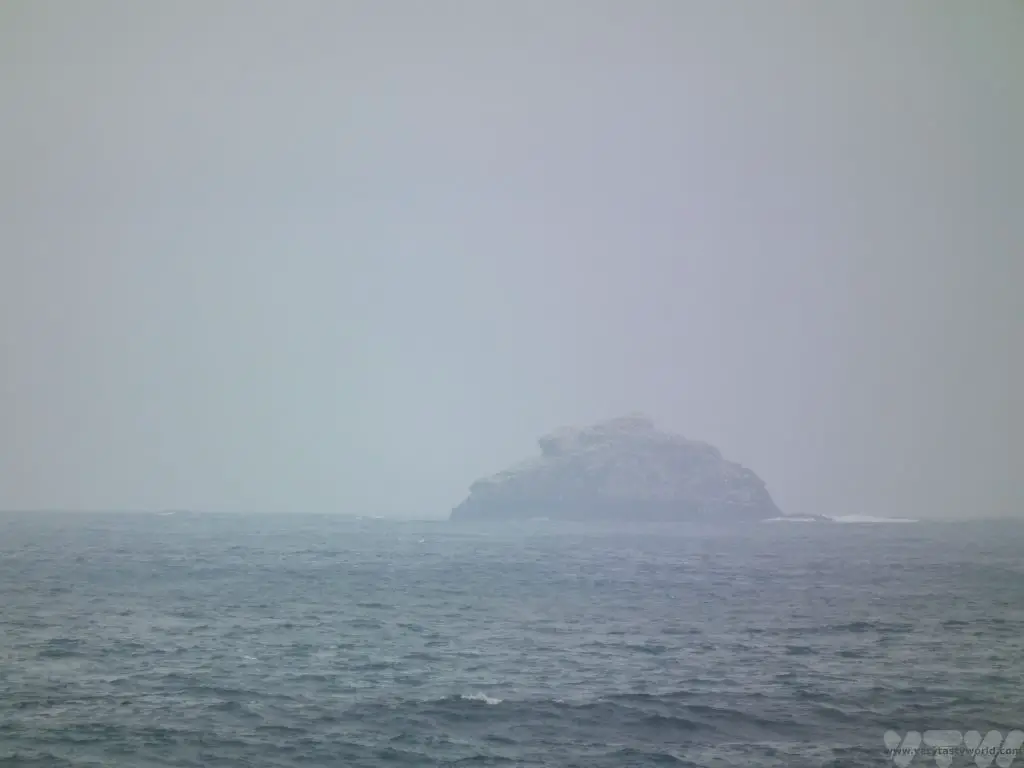
Heading towards Fort Tourgis, one of the many Victorian fortifications on the island, the coastline becomes rockier. Clonque (pronounced ‘clonk’) is a wonderful beach for walking and exploring. The bay overlooks the tiny uninhabited island of Burhou, a puffin colony, which is a protected site, and, further out to sea, the big oval rock Ortac, and Les Casquets with its automated lighthouse.
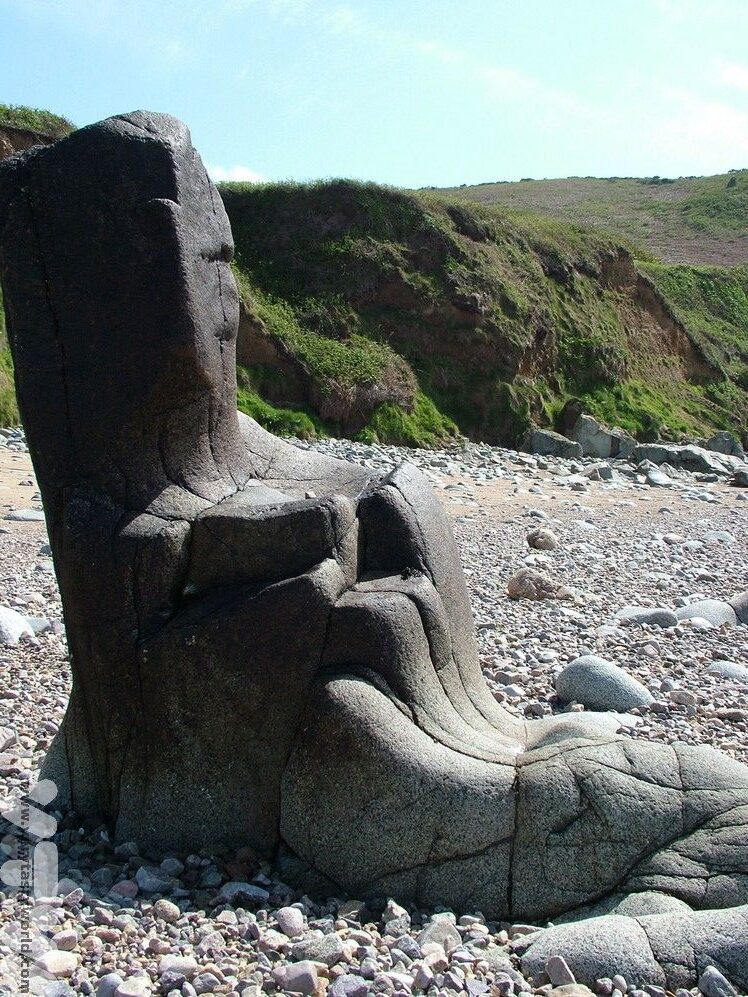
About two thirds of the way along the beach was a chair-like rock, known as the Monk’s Chair. Legend has it that a monk fought the devil there and, having vanquished his opponent, the monk sank onto the rock, whereupon it transformed into a chair to provide some comfort. However, this rock may well have succumbed to the merciless tides over the years.
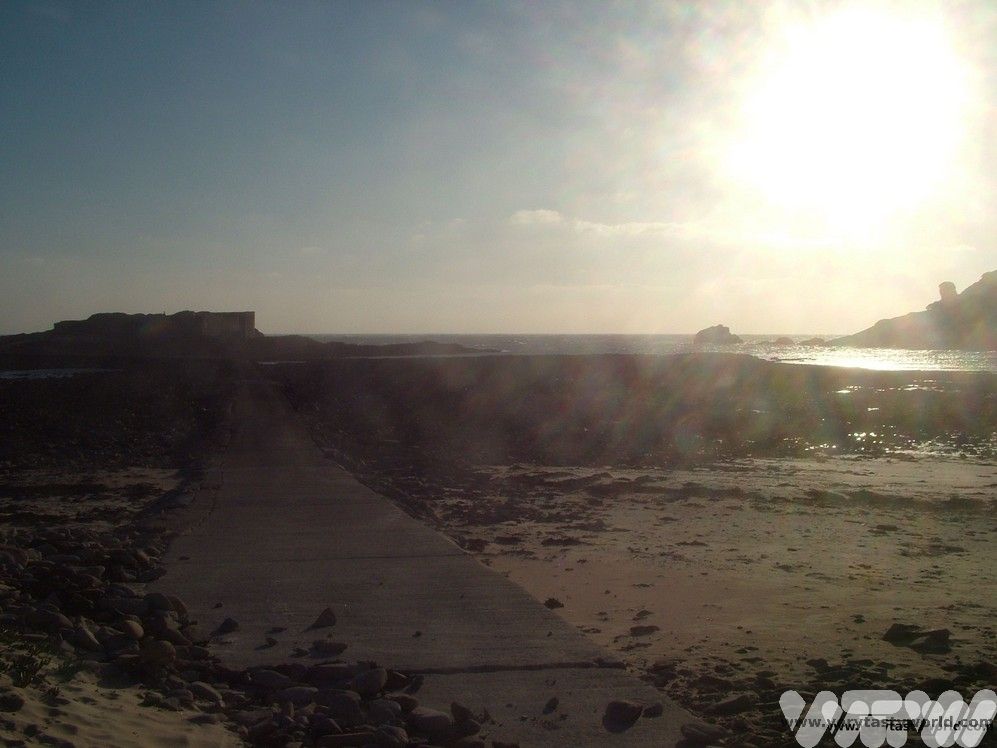
At the far end of the bay is Fort Clonque, another Victorian fort located on an island and accessed via a causeway, which is cut off from the main island at high tide. The property is owned by the Landmark Trust and it is possible to stay there. If you are travelling with a large group (it can sleep up to 13 people) it represents really good value and is a tremendous place to stay.

A Walk Around Alderney – Along The Cliffs
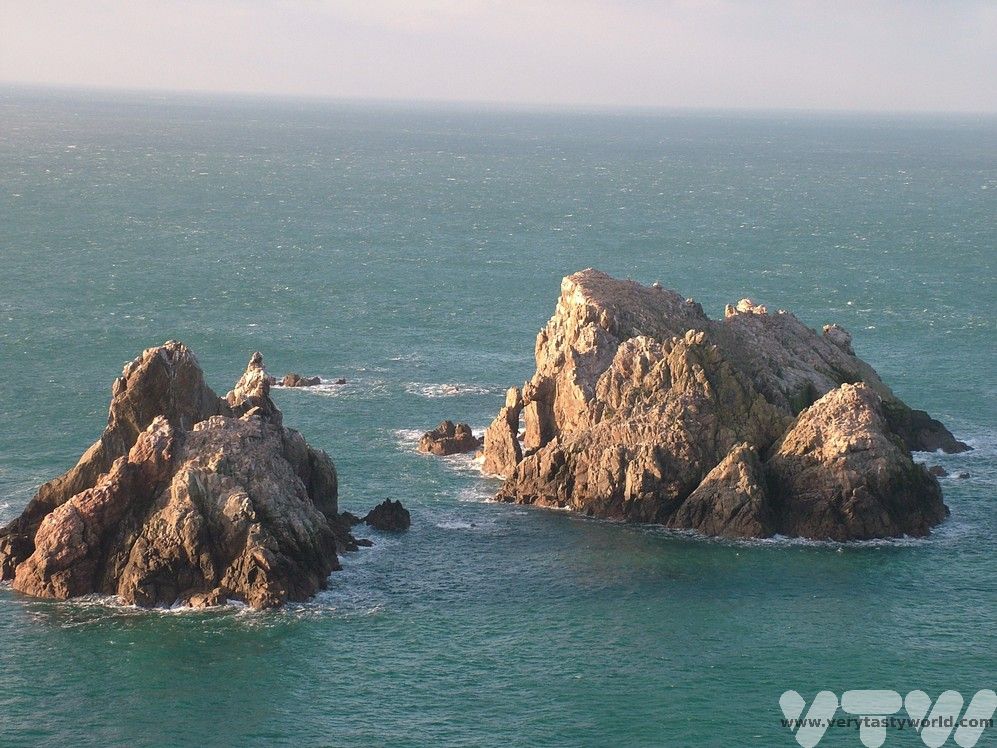
Continuing the walk around Alderney The terrain climbs rapidly and it is not possible to continue along the shoreline, so following a zig-zag up to the south-west end of the island it is possible to walk along the top of the windswept cliffs. Along the Giffoine you can look out to the Garden Rocks where a noisy gannet colony has made its home.
In this area there are several German fortifications from World War 2 when the island was occupied during the war and the local people evacuated. (The larger islands Jersey and Guernsey were also occupied and the residents remained under Nazi rule for five years.)
A walk along the undulating paths of the south coast is always a delight especially in spring and summer when the flowers are in bloom and the area is scented with the coconut smell of gorse.

It used to be possible to climb down steps cut into the cliff to reach the charming Telegraph Bay but the beach is now only accessible from the sea. The walk is adjacent to farmland so it is likely that you encounter some beauties such as these.
They are not Alderney cows, even though the breed is quite famous, having appeared a number of times in literature, from Jane Austen’s Emma to AA Milne’s poem, The King’s Breakfast:
The King’s Breakfast
The King asked
The Queen, and
The Queen asked
The Dairymaid:
“Could we have some butter for
The Royal slice of bread?”
The Queen asked the Dairymaid,
The Dairymaid
Said, “Certainly,
I’ll go and tell the cow
Now
Before she goes to bed.”
The Dairymaid
She curtsied,
And went and told
The Alderney:
“Don’t forget the butter for
The Royal slice of bread.”
The Alderney
Said sleepily:
“You’d better tell
His Majesty
That many people nowadays
Like marmalade
Instead…”
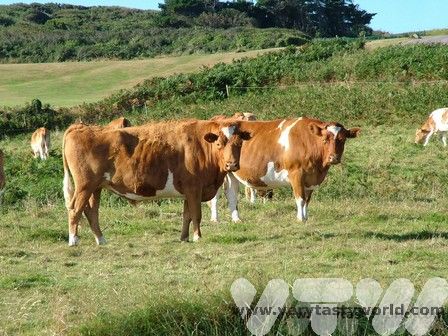
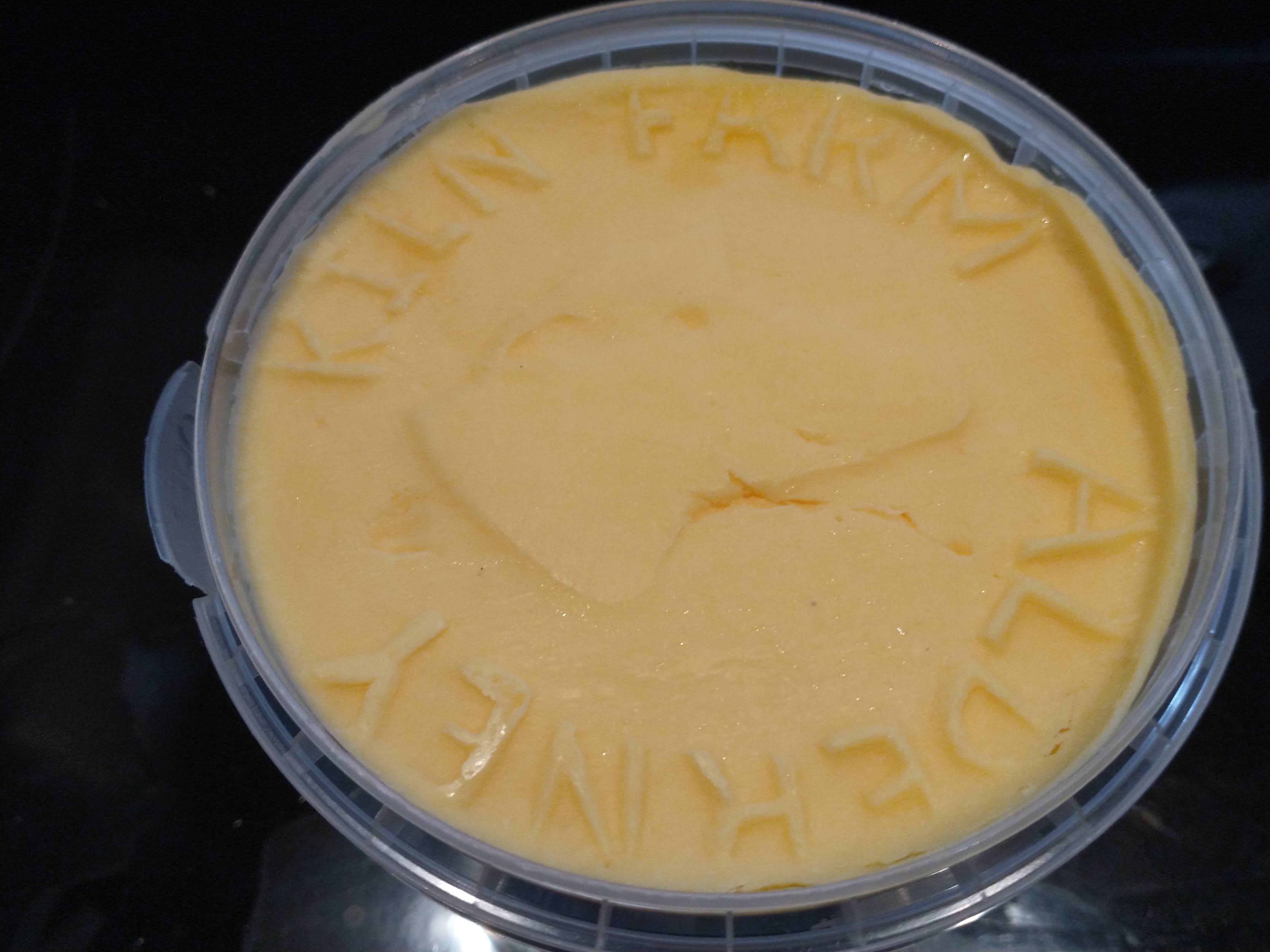
Sadly the breed was lost during World War 2 when the animals on Alderney were sent to Guernsey to help the islanders stave off starvation. But while the cows that graze on the lush grass may not be Alderneys, they do produce the most amazing dairy products. Alderney has its own dairy and produces a variety of delicious products including the creamiest milk and butter so yellow it rivals the colour of buttercups. It is absolutely delicious and a real treat to eat. Forget the marmalade, it’s best on bread, spread so thickly that you can see your teeth marks when you bite into a slice.
The journey continues past the airport along the cliffs to Essex Hill.
A Walk Around Alderney – Descent To The Beaches
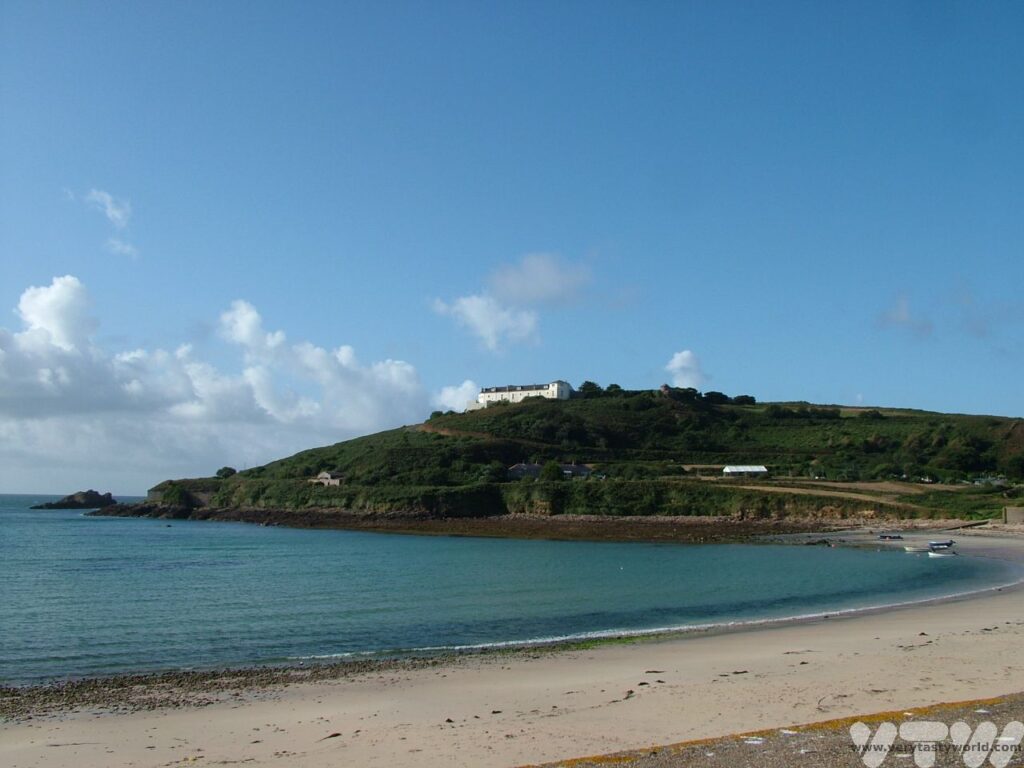
The Hanging Rock (far right of the picture) overlooks The Race, another treacherous tidal stream across a reef of sharp rocks and the cause of many a shipwreck over the centuries. There is a legend that the people of Guernsey tried to pull Alderney to across the sea by throwing a rope over the rock and having a really good tug… to no avail, of course.
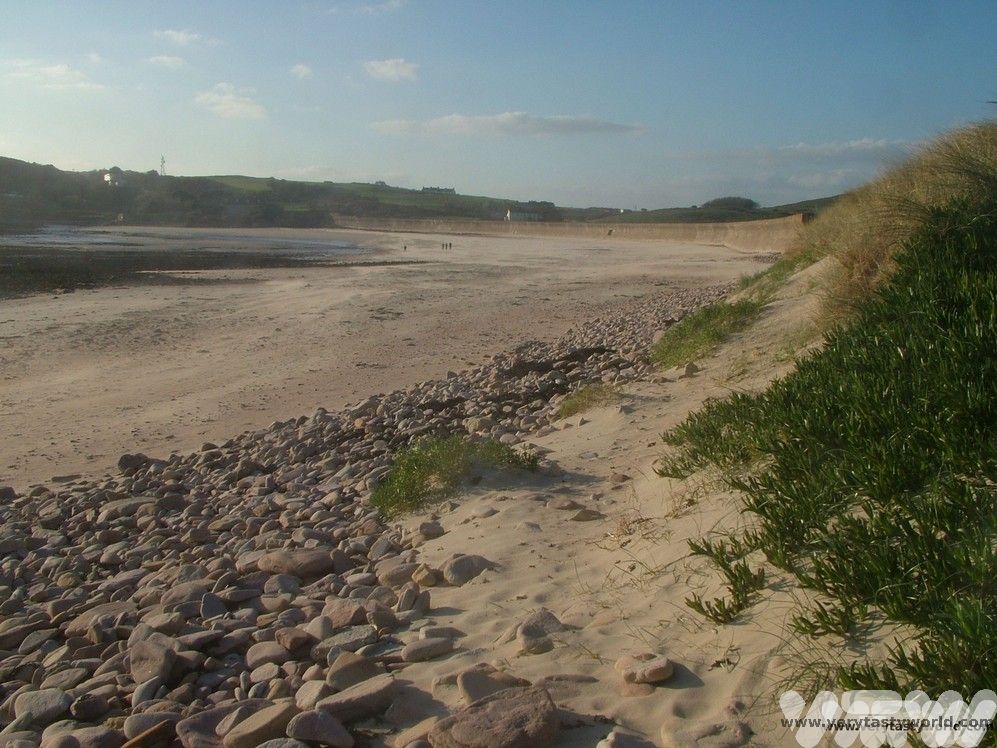
Then the cliffs fall away and you can stroll downwards to Longis Bay, Alderney’s original harbour. It’s a popular bay for bathing, the sandy beach shielded from the inevitable Alderney breeze by a concrete wall that spans the length of the bay, again built during the occupation.
Raz Island, with another fort at the end of the causeway marks the limit of the bay. There used to be some tourist attractions at the fort but it’s no longer possible to visit Raz, although some work is currently being undertaken to open it up again. A gentle stroll along the coast brings you to Houmet Herbe, a ruined fort again constructed on an island and only accessible at low tide.

Remnants of a basic causeway remain and, if you’re willing to scramble over the rocks, it’s possible to explore the fort. On a clear day you will get a fantastic view of the French coastline and Cherbourg, around 11km across the sea. Keep an eye on the tide, though, you will get cut off and have to wait a few hours for the tide to turn again.
A Walk Around Alderney – From The Lighthouse Back To The Beach
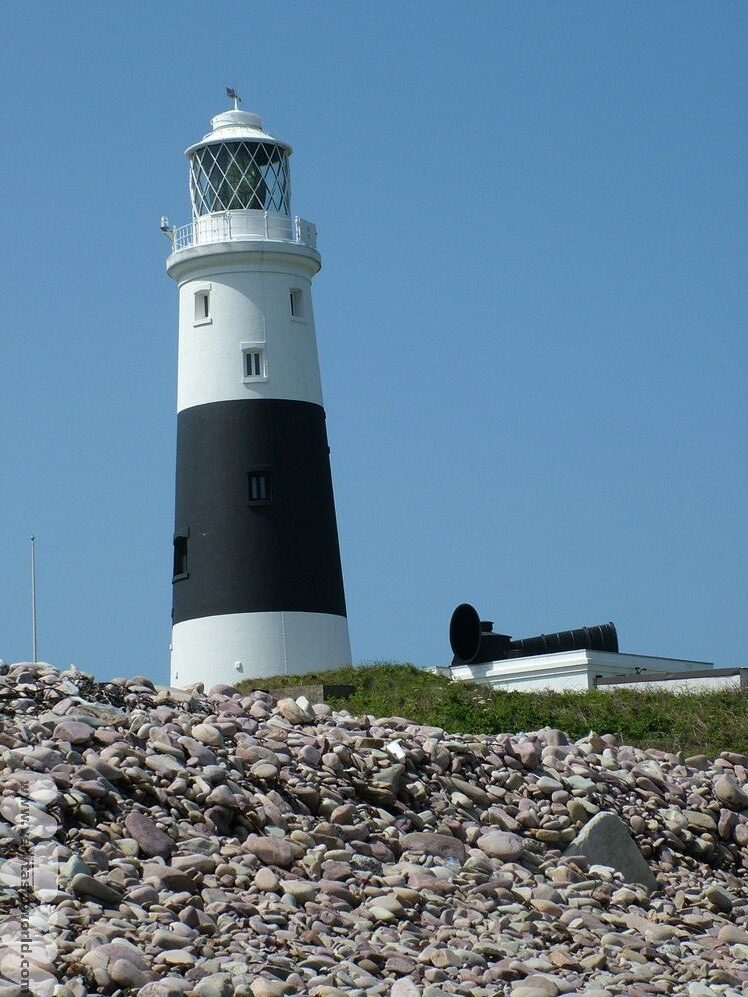
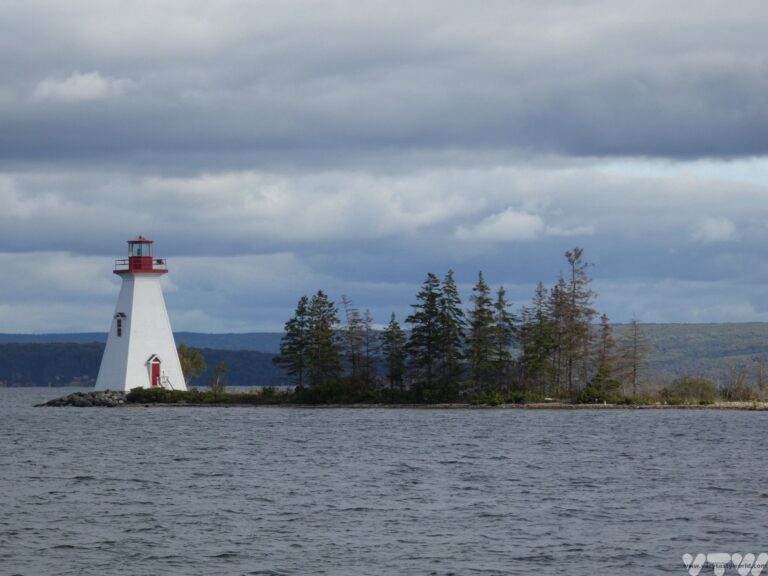
Continuing along the coastal path you will arrive at the island’s lighthouse. It’s fully automated these days.
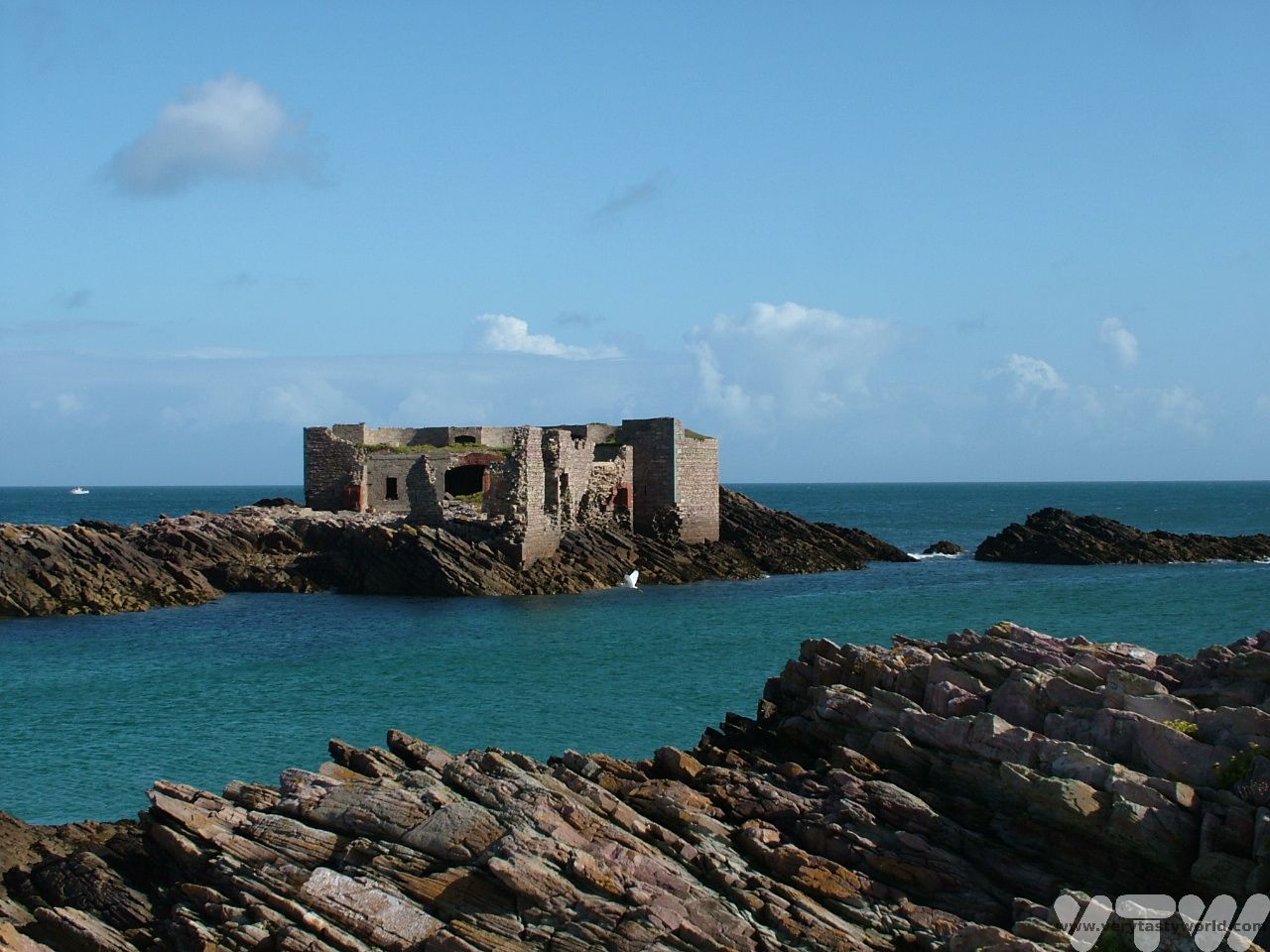
Opposite the lighthouse is Fort Les Hommoux Florains, which has largely been destroyed – each year battered by relentless winter storms. It is possible to get out there to view but you may need to swim across a small channel if the tide isn’t especially low, which probably isn’t worth the effort.
Close to the lighthouse, and overlooking Mannez quarry is a German fortification known locally as The Odeon. It is one of the most distinctive buildings on the island; an enormous concrete tower that was built by forced labourers in 1943. It was planned to be used as a range-finding location to observe enemy ships. It was derelict for many decades but it is now possible to visit The Odeon.

Also at Mannez Quarry is the end of the line for the Alderney railway. Yes, those are London Underground carriages in the photo below! The railway was originally constructed to bring stone from Mannez to the harbour for construction of the breakwater. It is now open as a tourist attraction for passengers to enjoy a delightfully scenic journey to the quarry from Braye station.

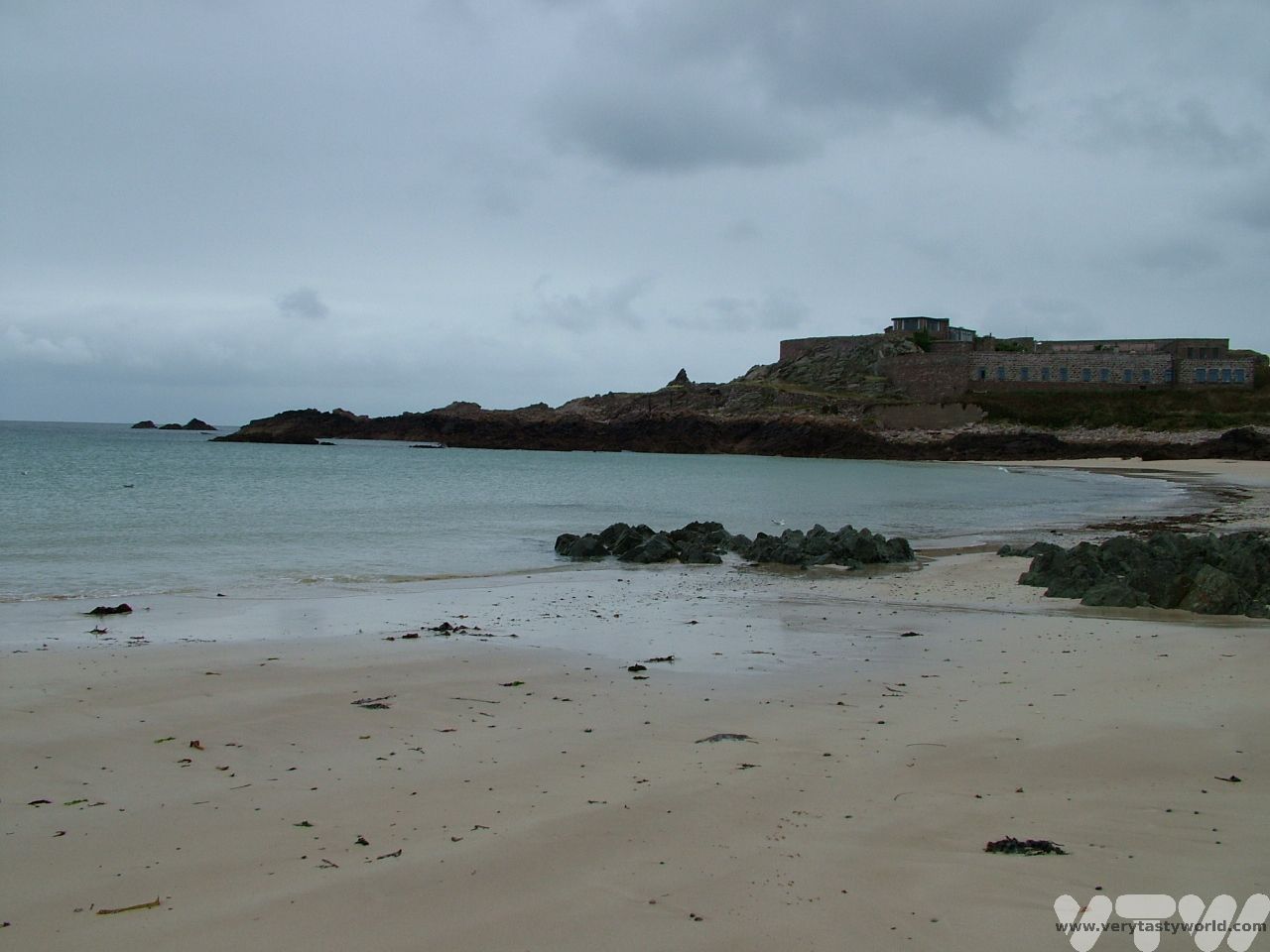
Further on (and don’t tell anyone) are the very best beaches for bathing: Corblets, Arch and Saye (pronounced ‘soy’). Overlooked by private residence Fort Corblets, the eponymous bay has a broad sandy beach and is popular for an energetic and invigorating swim. It’s worth bearing in mind that the sea temperature can be pretty cold, even in summer, but the water is crystal clear and it’s an absolute delight to swim there. (You do warm up!)
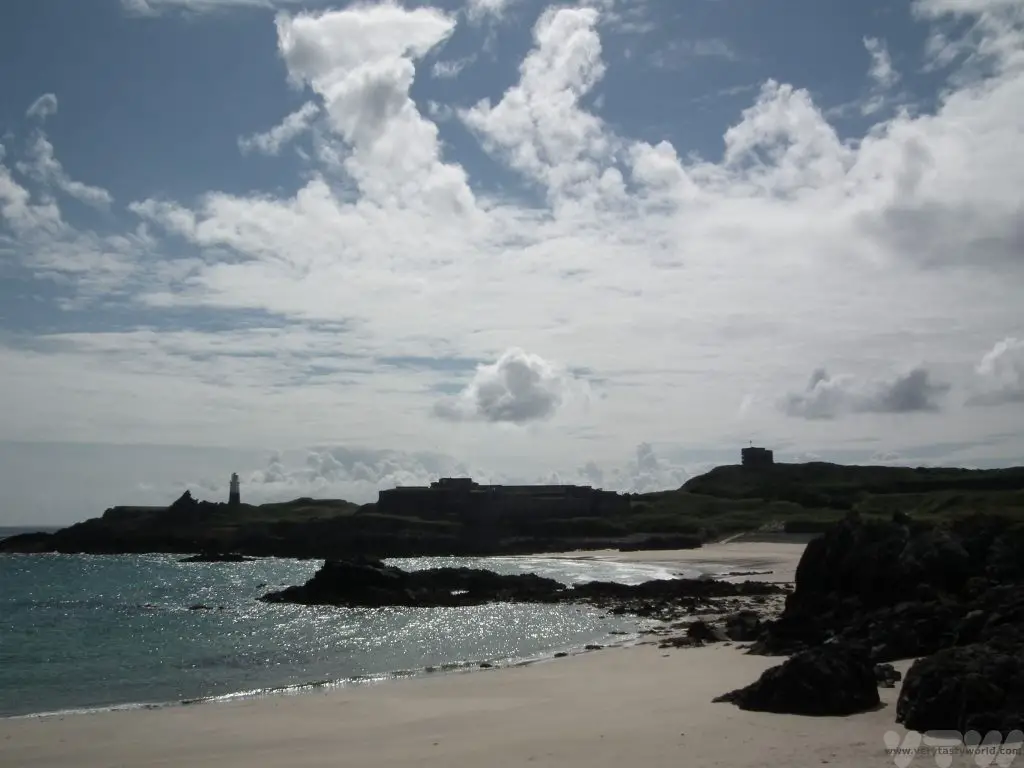
Arch is also sandy but has a steep incline. It affords a good view of the lighthouse and Odeon.
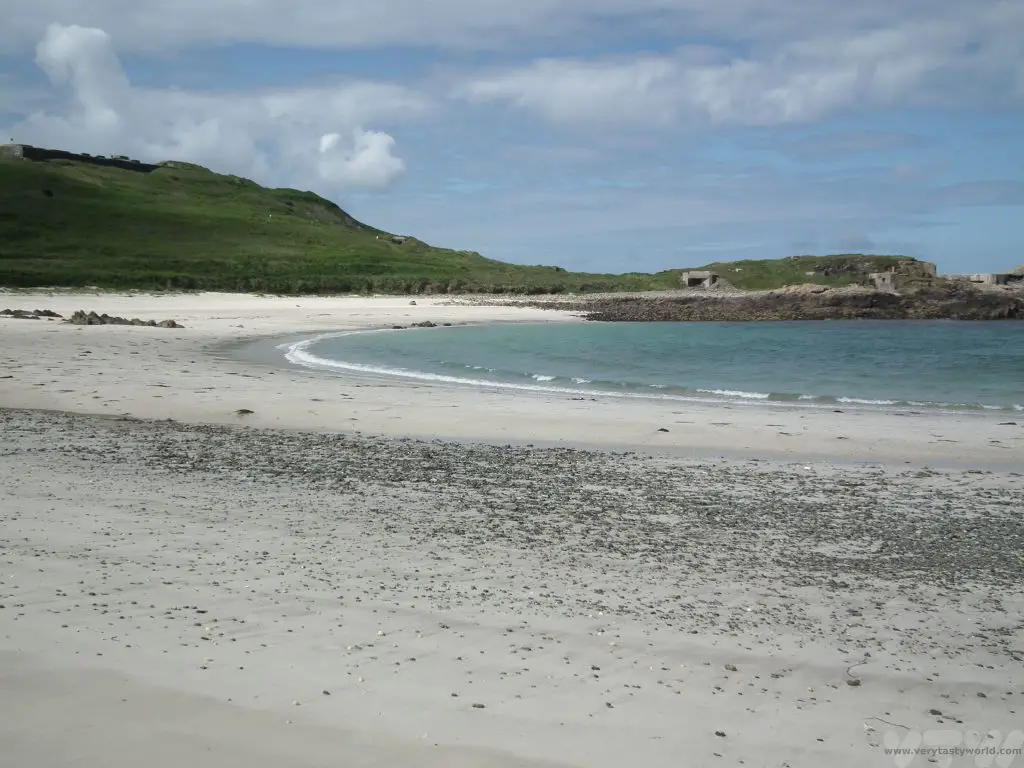
Saye can be found by walking underneath Arch Bay’s arch, past Château à L’Etoc (another privately owned fort) and beyond the dunes beside the island’s campsite – again it’s sandy but the enclosed geography of the bay ensures that the sea is much calmer than on Corblets.
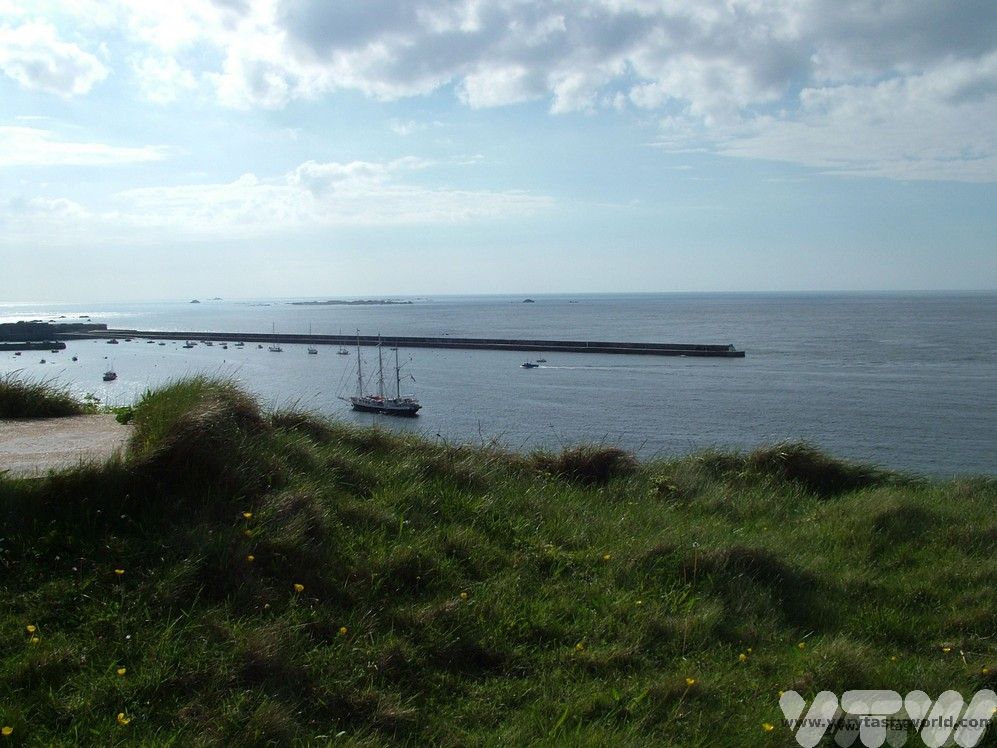
To complete the walk around Alderney it’s simply a walk around the grassy headland upon the top of which Alderney’s largest Victorian fort is located, Albert, originally designed to protect the harbour, and the familiar view of Braye, the harbour and the breakwater come into view. Burhou, Ortac and Les Casquets can also be seen in the background.
Related Posts You May Enjoy








Amazing pictures. I am glad you shared this place with us because otherwise, I would not have known about it or been able to enjoy it.
Thank you for your kind comment. Alderney really is a very special place.
There is so uch more here than I imagined. I always thought of Alderney as pretty deserted. However the breakwaters, Forts, lighthouses, Odeaon, quarry and those London Underround carriages have chaged my mind. Love the way you have done this as a walkabout as I usually walk for ages on any trip to see sights. It’s certainly one I would take on a Summer’s day to enjoy the beaches you mention too. Thanks for the info
Thank you! We love walking too – it’s a really great way to see a new location. Alderney is perfect for walking, although you’re right, this one is perfect for a summer’s day. There is a lot of visit on the island – the train ride is really enjoyable and very scenic.
It’s interesting how many forts there are on what sounds like a pretty small island. It makes sense, though, considering it’s location. Did you tour Odeon? I’m surprised it wasn’t torn down after the war.
It really is a heavily fortified island, as you say, due to its location. Most of the German fortifications around the island remain, including the long wall at Longis bay. The cliffs at the Giffoine have a network of bunkers. We haven’t had the chance to visit the Odeon yet but used to go inside when it was derelict.
I don’t know what it is, but being on an island really attracts people. The idea of getting away from all the crowd and living by oneself always seems fun. Well, until we get quarantine at least.
Islands are indeed lovely places to visit. Alderney is very special
This is such a beautiful little area, I’d love to visit here the next time I’m over in the UK!
Thank you. It really is a very special place.
Beautiful article. Never heard of this place before.
Thank you so much. Alderney isn’t well known but it is very lovely indeed.
I have relative living in Guernsey and have explored the islands around but have not yet got to Alderney — that will be corrected on my next visit to the area. The history of the Bailiwick is fascinating and the signs of the German occupation are everywhere. You’ve captured the essence of the island well.
Lyn | http://www.ramblynjazz.com
Thank you. It’s so nice to hear that you know Guernsey. We definitely recommend a trip to Alderney when you next visit as it is a lovely island and surprisingly different to Guernsey.
I’m ashamed that I’d never heard of Alderney and happy that you’ve written this article about visiting the island.
The landscapes are incredible, still in a very natural state and with a toughness typical of northern European seascapes.
It’s incredible how the marks of history endure over time and the traces of the German passage are still visible, not letting us forget the recent past.
Thank you! Alderney is not well known but definitely loved by the people who know it. The landscapes are really gorgeous and so diverse for such a small island – from sandy beaches to dramatic cliffs.
I have heard of Alderney albeit vaguely before and reading about it made me dreamy! It is certainly a gorgeous place to visit not just for summertime walks but probably to escape the city chaos or retreat from the world in general. I can see myself using the setting and landscape to perhaps write short stories about island life and cats. I need to visit Alderney soon! Thanks guys for highlighting yet again another special place! 😉 #flyingbaguette
Jan – https://flyingbaguette.com/
Thank you! You’re right that Alderney is the perfect place to get away from it all. We’d love to read your stories about island life and cats!
I haven’t been to any of the Channel Islands, which is crazy to think considering how much I loved watching Bergerac when I was a kid. Different island, but still. What a lovely place Alderney looks, and I can really imagine taking such a walk around this beautiful island. Small but mighty it seems from the pics, those cliff views are spectacular
Haha! We remember Bergerac as well! Alderney really is a beautiful island, much smaller than Jersey – I think you’re right “small but mighty” sums it up very well.
I feel like any island in the English Channel would have a lot of stories to tell from history, especially wwII. What a fascinating place to visit with some gorgeous views. I’d love to walk to the lighthouse!
Alderney is a very special place. It does indeed have an interesting history. The lighthouse is great – you used to be able to visit it and climb to the top but sadly it’s all automated these days.
For such a small island there sure is plenty of forts and abandoned places. What a delight for exlorers and the deserted beaches with fine powdery sand would appeal to me. This is such a remote location and quite the adventure to get to. I take it it requires some efforts and time, therefore one would need to stay overnight on the island. Do you have any insights on accommodation options and how many days one should consider for a stay?
Carolin | Solo Travel Story
It really is a magical place. Yes, Alderney can be a bit tricky to reach but you can fly in from the UK. There are more transport options if you travel from Guernsey, its sister island. There are lots of accommodation options from hotels to Airbnb and there’s even a campsite! We’d recommend a few days on Alderney but you could also do this walk as a day trip from Guernsey.