
How To Say Thank You For The Food in Japanese
The Japanese language has many phrases that are commonly used as part of everyday life. Japan is a country where politeness is important. Learning how to say thank you for the food in Japanese is always appreciated whether you are dining at a restaurant or at someone’s home. And while saying thank you is important, there are other etiquettes to consider when dining in Japan.
How To Say Thank You For the Food in Japanese
If you enter a shop or restaurant in Japan you will be greeted with a hearty, ‘Irasshaimase!’ a polite acknowledgement that you, as an honoured customer, have visited the premises – literally it means, ‘you are here’.
There are two phrases that are always associated with eating. The first is ‘itadakimasu’ which is said before eating your meal. It means ‘I will receive’ but is often interpreted as ‘bon appetit’. Most people place their hands together and bow their heads slightly, as a means of showing gratitude for the food.
At the end of the meal, when the food has been consumed, people will say ‘gochisosama’ or ‘gochisosama deshita’ if they are being polite. Its translation is ‘this was a real feast’ and is used as a way of expressing appreciation for the food. We have used this phrase many times when we have eaten in restaurants in Japan and it is guaranteed to raise a smile from the chef, who appreciates the appreciation.
The word for ‘delicious’ in Japanese is ‘oishii’. Chefs will definitely be happy to hear you say this. At the end of the meal you can say, ‘oishikatta desu’ – it was delicious.
Japan has a thriving social drinking culture. If you are lucky enough to join a group of local people who are enjoying a few tipples, the phrase ‘kampai!’ is the equivalent of ‘cheers!’.
Japanese Dining Etiquette
Although saying thank you for the food is important, there are a number of other etiquettes associated with eating and drinking in Japan that are worth knowing.
Eating Etiquette
Japanese food is eaten with chopsticks. The correct etiquette is for the chopsticks to be laid in front of you, horizontal in line with the edge of the table.

When you are having a pause from eating, place the chopsticks on a rest in front of you, don’t place them on a bowl of food.
Never point to anything with your chopsticks, that is considered rude.
If you are using chopsticks make sure that you pick up the food with them – never stab it. If you are choosing from multiple dishes, don’t wave your chopsticks over them.
Similarly, don’t pull a dish closer to you using the chopsticks – pick up the dish and use your hands to move it closer to you.

Never stick your chopsticks vertically in your rice bowl – this is a big taboo as it resembles incense sticks as an offering to the dead and is considered to be unlucky.
Do not pass food from your chopsticks to the chopsticks of your dining companion as this recalls a funeral ritual.
If you are drinking soup from a bowl, you can use a spoon but it is also okay to bring the bowl to your lips and drink directly from it. (Korean etiquette requires that you use a spoon.)
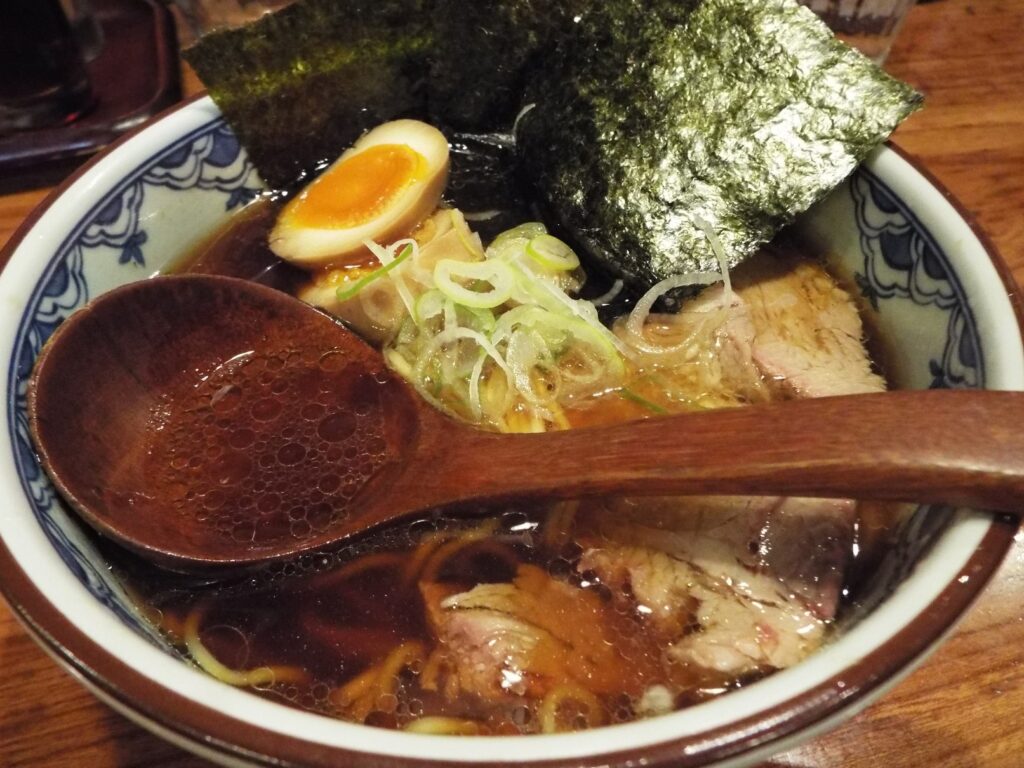
If you are eating noodles, or drinking soup or broth from a bowl, it is polite to slurp. This has two effects – it is considered polite because it shows that you are enjoying you meal and it also has the effect of cooling down the broth. As Brits who have been brought up not to slurp soups, it can be quite difficult to learn to slurp with enthusiasm!
Drinking Etiquette
When drinking it is considered polite to pour drinks for your companions and not yourself – your companions will reciprocate.
If it’s a casual situation you can pour for everyone and then pour for yourself, but in a more formal environment you wouldn’t pour your own drink. When someone offers you a drink, hold your drinking vessel, usually a glass or a sake cup, with both hands while your companion pours for you. Similarly, when pouring, use both hands.
If you are receiving sake, it is polite to look the person who pours your drink in the eye. Sake may be served in a short glass or a square wooden box, which is known as a masu cup. Originally the masu box was used as a rice measure. Sake is a celebration drink and is often served into a glass which is inside the masu cup – and filled to overflowing. This represents generosity. If you are served sake inside a glass in a cup, sip the sake from the glass first. Then you can pour the overflow into the glass when there’s enough room. But there is no fixed etiquette.

Although, as a visitor, you wouldn’t be expected to know the traditional phrases or etiquette, when you eat out in Japan it is always appreciated it you get things right.
We hope you’ve found these phrases and etiquette tips useful. Enjoy eating and drinking in Japan. Kampai!
Related Posts You May Enjoy



- Just for the Hell of It – The Hells of Beppu

- Five Wonderful Places to Visit From Tokyo

- Amazing Japanese Black Sesame Pudding Recipe

- How To Say Thank You For The Food in Japanese

- What To Know Before Visiting Japan
- Where To See Snow Monkeys In Japan

- Is Kanazawa Worth Visiting?

- RECIPE: How to Make Sushi Ginger – Gari

- Kobe Beef in Kobe – Is It Worth It?


Thanks so much for reading. We hope you enjoyed this article. If you’d like to keep up to date with new posts and recipes, please subscribe to our newsletter or follow us on social media – Bluesky, Facebook or Instagram. We always love hearing from you and would be delighted to read your thoughts about this article.


