
Rivers and Rainforests – A Guyana Itinerary
Guyana is one of the most densely forested countries in the world. Located in the northeast of South America, over 90% of its landmass is covered in lush rainforest. One of the things we most wanted to do on our recent visit was to explore the rivers and rainforests of this fascinating country. Here is our Guyana itinerary.
In order to make this journey we found a local tour operator, Adventure Guianas, who were able to book the accommodation for us and arrange the transfers between locations. Guyana receives very few visitors. Only around 5000 people visit purely for tourism each year. Indeed, outside Lethem and Georgetown we didn’t see any other visitors at all.
Where is Guyana?
Guyana is a small country which borders Venezuela, Brazil and Suriname. It was the only British colony in South America and hence the only country in this continent which has English as its main language. The country gained independence in 1966. Guyana is a word derived from the indigenous language and means ‘The Land of Many Waters,’ a description that couldn’t be more appropriate.

In his book, 92 Days: Travels in Guiana and Brazil, Evelyn Waugh travelled to the interior of Guyana in 1932, around 92 years before we made the journey. He didn’t seem to have a very good time at all. Waugh was a British novelist who had just been through a divorce and had decided to travel to pretty much the most remote area he could think of. So he probably wasn’t in a very good mood.
Waugh found it difficult adjusting to slow travel (in an era of much slower travel) through a challenging landscape and didn’t seem to understand the cultural differences. It was fascinating to read about his visit, embarrassingly patronising colonial language aside, and to see some of the places he described. Apparently it inspired the conclusion to his novel, A Handful of Dust.
What To Expect When Travelling Through The Rainforests of Guyana
There is a lot of travelling between locations but the scenery is spectacular and there are always wildlife viewing opportunities along the way. We were also interested in learning about the local culture, especially the indigenous people of the region. We were delighted that we were able to stay in lodges run by local communities.
Get ready for some early mornings. When we were out on excursions to look for wildlife, we’d be out very early in the morning, when the animals and birds were most active. We’d then have an afternoon siesta, when the sun was at its hottest and the wildlife was also avoiding the heat of the day. In the late afternoon/early evening, as the sun started to go down, we’d be out again, exploring the rainforest and the rivers.
The weather is hot and humid all year round. The country has wet and dry seasons, but the temperature is around 25-30C every day.
Guyana is close to the equator, so sunrise and sunset are around 6am and 6pm respectively, with a small variation (about half an hour) depending on the time of year. In the rainforest there is an insect which is called the 6 O’clock Bee, a cicada which buzzes like a chainsaw in the morning and evening, bang on time every day.
Many of the lodges we stayed in either didn’t have electricity or had solar electricity which stopped when it was dark or ran out when the battery had drained down. There was no aircon at all, but most lodges were able to supply a fan to help us keep cool… until the electricity ran out! Power banks are useful if you want to charge any electronic equipment when there is no electricity.
Some lodges had wi-fi, some didn’t. Some only had internet access in communal areas. Whenever we couldn’t get online, it was a good opportunity to switch off the phone and get away from the modern world for a while. We did take a small tablet device with us so that we could read books or watch some films offline while we were resting during the middle of the day.
Showers were always cold water but this wasn’t a problem as it provided a lovely relief from the heat. No toiletries were provided, just a bar of soap..
Creature Comforts?
There will be critturs in your room. We found it delightful that birds and bats were flying into and around our room or that frogs were hopping around the bathroom. It felt as though we were part of the natural environment.
Keep your bags zipped up so that nothing can crawl inside them when you are not looking. And you need to be aware of bat droppings – we recommend keeping your bags under the bed or underneath a shelf to avoid them being covered in yucky poo pellets in the morning. Also, beware of where you tread with bare feet.
Shake out your boots before putting them on! You never know when a scorpion has snuck inside. Our boots were generally empty each day, although Mitch did find a teeny frog in one of her boots on one occasion. It probably wasn’t harmful but a shake-out avoided it getting crushed by her foot.
You’ll need to sleep under a mosquito net. Insect repellent is also essential. We still got bitten to shreds as the nasty little insects took advantage of even the smallest patch of unsprayed skin. We are clearly delicious to the local mosquitoes! So we also made sure we had had our Yellow Fever vaccinations and we took anti-malarial pills throughout the trip. Check vaccination requirements with your healthcare provider.
We advise packing light because we there is a lot of travelling and we didn’t want to lug heavy bags everywhere. Most of the lodges are able to do laundry, some include it in the cost of the stay, others will charge a small fee.
A Two Week Guyana Itinerary
Our trip to Guyana started in its capital Georgetown, on the Atlantic coast. Most of the country’s population live along the coast. Around 90% of the people live on 10% of the landmass. Of the people living in the rainforests in the interior of the country, the majority are indigenous Amerindians.
Our Guyana itinerary largely took us to the interior of this amazing country. This is a full-on journey which took two weeks to complete.

Days 1-2: From the Coast To The Savannah
After spending a day in Georgetown, we flew to the border town of Lethem. The airport has a dirt runway and a teeny terminal. The aircraft is very small, less than 20 passengers. So your luggage will get weighed and so will you! There is ostensibly a 9kg hold luggage limit. We knew about this so packed as lightly as we could. Our bags were slightly over the limit and weren’t charged excess baggage but it’s worth knowing that there can be a charge. It’s a few dollars per extra kilogram.
Most tourists fly to Lethem – the journey takes around an hour – but it is possible to catch a bus from Georgetown. Travelling by road takes around 12 hours and this time does depend on the limitations of the ferry across the Essequibo river.
Lethem is a strange little town, located right on the border with Brazil, separated by the Takutu River which delineates the border. The lovely driver who greeted us at the airport described it as ‘small but nice.’ It has a suprising number of large retail outlets selling all sorts of consumer goods which are generally more expensive in Brazil. So it receives carloads of visitors who cross the border just to buy things. And many Guyanese cross to Brazil to pick up goods that are cheaper on that side of the border.
We didn’t spend much time in Lethem. Our itinerary was to take us across the savannahs and through the rainforest, staying at various lodges along the way. It was a circular route, anti-clockwise, starting and ending in Lethem and much of our journey was by river.

Day 3: The Savannah To The Rainforest: Lethem To Yupukari
On leaving Lethem, our first port of call was the Yupukari Amerindian village, home of the Macushi and Wapishana groups. It took a couple of hours to reach there on a largely dirt road. We stayed in Caiman House, a lodge run by the villagers, who work within the business on a rotational basis, so that each member of the village gets employment from tourism. It was a lovely place to stay – we had a large room within a small complex which included a sitting area and library.


We spent some time walking around the village and were introduced to the staff and children frequenting the local library.
In the evening we enjoyed a boat trip along the Rupununi river, spotting birds.


At nightfall, we met up with a caiman monitoring team. Caiman are members of the alligator family and the team run a project surveying and monitoring these creatures in the river. This project is funded entirely through tourism.


We observed the capture of a caiman, a male, number 836, who was caught and measured. He was fairly big at 1.66m long. Once all the data had been recorded he was released and he slunk back into the murky waters of the river.
Day 4: Yupukari to Rock View
The next morning we were up before sunrise in order to go out into the Savannah to see if we could find giant anteaters.
The grassy plains of the Savannah offer an ideal environment for termites. You can see their impressive mounds dotted like fluffy grey bushes throughout the landscape. And where there are termites there are anteaters. These extraordinary and slightly bizarre-looking creatures amble through across the Savannah in order to enjoy snacking on the insects.


After around half an hour criss-crossing the various trails, a local spotter found one, sauntering across the grassland, feeding at termite mounds and trees.

We then left Yupukari and hit the road for a couple of hours before reaching the foothills of the Pakaraima Mountains. Rock View Lodge is run by an Englishman and his family.

We enjoyed some walks in the area as well as trying local food, especially a demonstration of how to roast cashew nuts.
The family were very hospitable. We were invited to tea and biscuits at tea-time and to enjoy a rum and lime aperitif, with delicious cashews, before dinner. They were also keen to make sure that our transfer the following day could be adjusted because the planned river journey on the Rapununi was not going to be possible due to ultra-low water levels.
Day 5: Rock View To Rewa Amerindian Village
Sadly, we missed the river journey and had to drive to the landing. We were impressed at how all our hosts communicated with each other and went out of their way to ensure that the transfer went as smoothly as possible. The landscape transitioned from bone-dry Savannah to the lush rainforest. When we arrived at Rewa we were picked up to be taken to our next lodge.

Located at the confluence of the Rapununi and Rewa rivers, this is another Amerindian village community which has set up an eco-lodge. We stayed in benabs with traditional roofs woven from dried palm leaves. There is a communal dining area and it has a bar.

We thoroughly enjoyed visiting the village with our Macushi guide to see how the local people live and work. Many of the modern buildings have been constructed by the government and include schools and community buildings. It was also great to see an IT centre which the villagers can use.


Many local people still live in traditional homes and practice the farming and foraging methods of their ancestors.


We were particularly keen to learn about Amerindian farming, food and cookery.

The staple food cassava is processed to form farine (a coarse flour) and beiju (cassava bread) as well as cassareep (a sticky liquid which provides lots of flavour in cooking, including in Guyana’s pepperpot dish). These woven matapi contain grated cassava. The cassava flesh will dry out to make farine and the juice will be retained to make cassareep. Fruit and vegetables are also important in the Amerindian diet. And, of course, the river supplies bountiful fish.
Sports play a big part of village life and the local teams regularly play matches against other villages. We watched the men practice hardball cricket and the women playing volleyball. And there was plenty of wildlife to see.


The only disappointment about this lodge was that we didn’t realise that they had a giant waterlily pond close by until it was too late to visit. We had wanted to see the Victoria Amazonica with its enormous leaves and sadly didn’t have time.
Day 6 – 8: Rewa to Piraiba Lodge. Days on the Essequibo River
Another early start, we were picked up by the Adventure Guianas team who had left their base location at 2am to reach Rewa.

This was our longest river journey. We spent five hours travelling downstream right into the heart of the rainforest in the middle of nowhere. The Rapununi met the Rewa and then flowed into the mighty Essequibo.
Part of the reason for the length of our journey was that the water level was incredibly low, exposing the rounded boulders of the river’s bed. Our boat was piloted by two Amerindian guides who knew the river intimately – the deep parts and the shallow sections, sending us from one side of the river to the other, negotiating rapids (think of a theme park ride with piranha!) and also kindly pointing out interesting birds and wildlife.

At times we had to get out of the boat and clamber over the rocks while our pilots carried the boat to deeper waters. It was a magical journey along a pristine river within a vast forest and we loved every moment.
We arrived at Piraiba Lodge, a wooden construction overlooking the river. And the only construction for miles around. The lodge is on stilts because the river levels rise significantly in the rainy season. Accommodation is basic but comfortable enough.

The hospitality at the lodge was fantastic. Many of the friendly staff are Amerindians who know the jungle and river well. Our local guide Lawrence looked after us beautifully, taking us on treks through the jungle and guiding us along the river.
We spent three nights here. Our mornings and evenings were out on the river looking for wildlife and we even tried our hands at fishing. Caiman live on the river nearby, gliding nonchalantly and slightly menacingly across the water. Some are up to 12 feet long. We made sure we checked for caiman if we ventured onto the beach.

Guyana is rightly a top destination for birding and we saw a huge variety of species.


Sadly, we didn’t see river otters but had an exciting moment when our host caught an electric eel… while we were sitting in a metal boat. These fish can discharge about 700 volts of electricity, so we really didn’t want to come into contact with it! Fortunately, Lawrence managed to pilot the boat to a sandbank and released the eel using a wooden implement. It swam away quite happily and nobody received an electric shock.
The forest comes alive at dusk. In the evenings the howler monkeys howl. Initially we thought the sound was the whoosh of the wind. But there was no movement of swaying trees. There is a legend that these monkeys hate drinking water directly from the river because they don’t like seeing their own reflection. They prefer to drink rainwater from leaves. And because we were visiting during the dry season, they were howling for rain. We saw a Red Howler in a tree, just hanging around on a branch on one of our jungle walks.

In the deeper parts of the river the Drum Fish lurk on the river bed. They make a rhythmic sound in the evening. Apparently they have muscles that vibrate causing a resonant noise within the swim bladder. If you’re fishing and want a catch, they just won’t bite when drumming.
As with all lodges, all meals and water were fully inclusive and at Piraiba we could help ourselves to unlimited soft drinks from the freezer. We were also treated to some local rum. And, quite unexpectedly, the staff washed our dirty clothes for us – which was really helpful.
The food was great – lots of river fish, enhanced by vegetables, including some mega-hot little yellow chillies that grow on the adjacent land. Pork cooked in cassareep, the sweet reduced casssava juice, was sticky and sumptuous. And our hosts caught a red paku in the shallower waters one day and this was roasted for dinner that evening.
Day 9: Atta Lodge and the Iwokrama Canopy Walkway
After our stay at Piraiba, we boarded the boat again and travelled further downstream for a couple of hours to Fairview Amerindian village. It was another lovely journey, especially as we traversed the rapids.
We said goodbye to the marvellous Essequibo and started the journey inland.
The next stop was the Atta Lodge where, once again, we received a friendly welcome. We had a lovely room and electricity throughout the night. Joy! There are a couple of Black Curassows living nearby that strut inquisitively across the lawn showing off their delightful curly crests.

The lodge is located around a kilometre from the Iwokrama Canopy Walkway. This is a fantastic initiative, developed and constructed by local people, where you can climb up to a treetop canopy suspension walkway, 35m above the ground.

The walk isn’t too onerous – a climb up the hillside followed by some steps which take you up to the treetops. Then you can walk across suspension bridges to the trees and be amongst the birds.

We visited in the evening and again in the early morning, in order to see the birds of the region when they were at their most active.


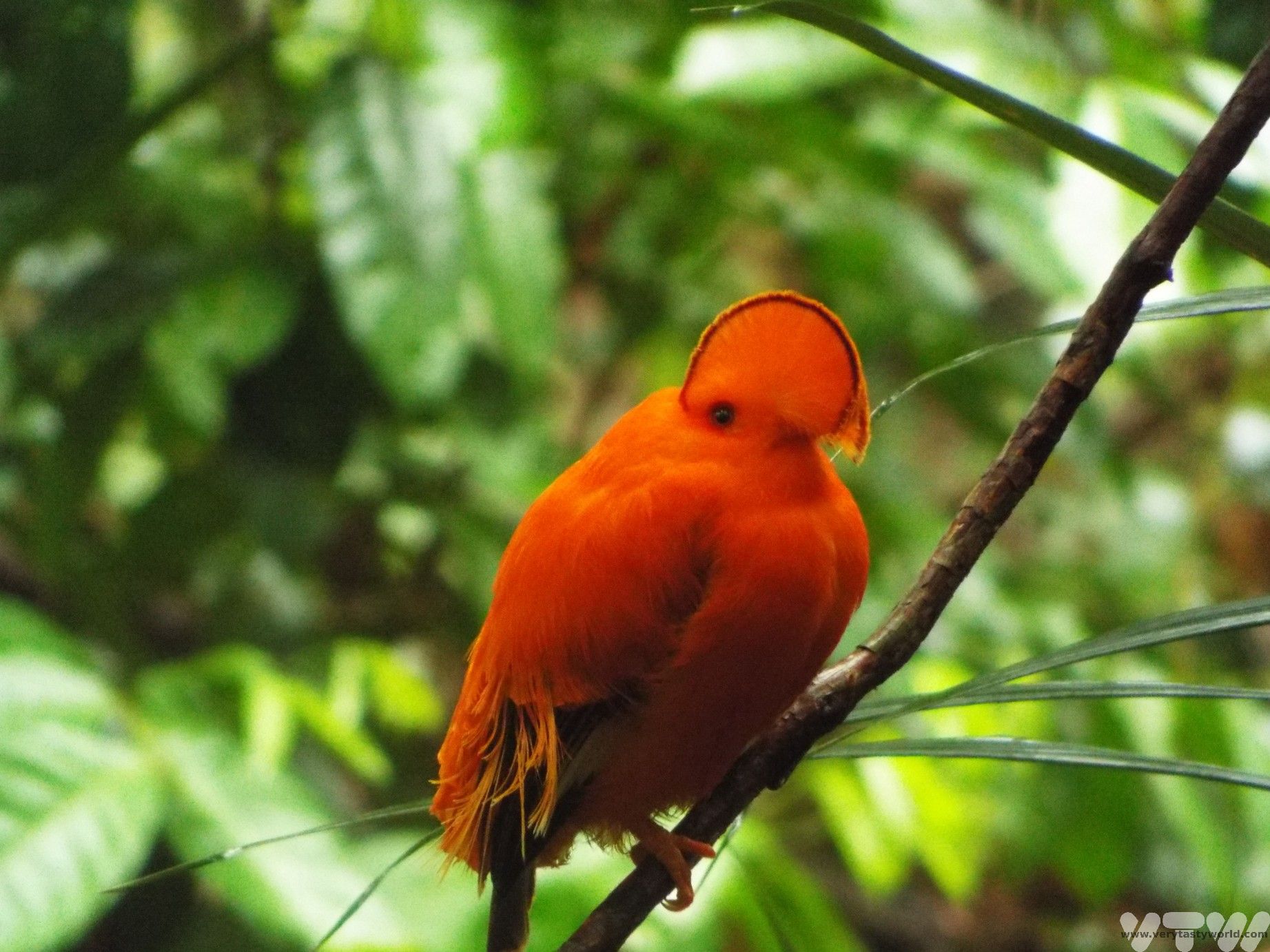
After leaving Atta we made our way to the next lodge but stopped off on the road to see a very, very special bird. The Cock of the Rock is one of the most striking birds we have ever encountered – a brilliant orange colour with a distinctive head crest and fluffy feathers.
A short walk of around one kilometre took us through the jungle until we reached the rock of the Cock of the Rock. Mrs Cock of the Rock was in the nest looking after Cock of the Rock junior. She viewed us with a small degree of suspicion.


We walked a little further to see whether the male would make an appearance. Our guide used a phone app to imitate his call and, sure enough, curiosity got the better of him and he appeared, posing proudly to show off his magnificent plumage.

Day 10: Surama Eco Lodge
Then we journeyed on to Surama Eco Lodge. Another lodge set in the village of the Macushi people, we were given a tour of the area by a local guide and also enjoyed a walk through the rainforest.
Surama’s accommodation was a bit more basic. Although the room was lovely and large, there was no electricity during the daytime and a generator ran for just four hours in the evening, between 6pm and 10pm. However, the wide windows of the benab took advantage of the breeze blowing through.

We also had a number of visitors to our room, including house wrens that had built a nest in the rafters of the roof and were flitting in and out of the eaves. And a cute little frog in the shower room.


The village comprised traditional homes which were located around a shared communal area. There were two schools, a computer centre, a church, a social club and a sports stadium. We learned about life in Surama – how the residents form a council to decide about village matters.


The totem pole at the village entrance represents the indigenous peoples and depicts humans at the bottom and creatures of the rainforest in a vertical design. This includes an eagle, fish, snakes and a jaguar.

Surama Eco-lodge was very accommodating in terms of cooking local food for us. We’ve discovered over the years that it’s often okay to ask your hosts if they would kindly prepare a local breakfast and every time, they’ve been more than happy to do so. On this occasion, it was difficult to supply breakfast but they provided us with a splendid feast for lunch instead:
Pork cooked in sticky cassareep, farine and callaloo (a leafy plant cooked a bit like spinach) with garlic. It was accompanied by cassava bread, which is more like a biscuit, but perfect for absorbing all those delicious meaty cassareep juices.


Day 11 Back to Lethem
Then we returned to Lethem, a couple of hours’ drive away on a bumpy, dusty road. We popped over to Brazil in the evening, crossing at the Takutu River bridge.

This was the easiest border crossing we had ever undertaken. No need even to show passports (although we carried them with us as the border guards may do spot checks). We had a brief look around Bon Fim, which was pleasant enough but unremarkable.
There are a lot of ranchers in the area, both in Guyana and Brazil, and rodeos are held in both countries. The rodeo is hugely popular – it’s a real family event with funfair rides and music concerts in addition to the main attraction. Accommodation at both locations will be absolutely packed out when the rodeo is in town, so it’s worth considering when rodeos are taking place and booking accommodation early if possible. Many people were buying hammocks so they could sleep outside.
Day 12 Kunaku Mountains
Our final day in this area was a day trip across the savannah to the Kunaku mountains, located a short half-hour drive from Lethem. The Kunaku are considered sacred by the Macushi and Wapishana people who live nearby.

We enjoyed a hike up and down the mountain with a local guide and then relaxed by the river. There was a BBQ area and we enjoyed a delicious roasted Tambaqui fish, a delicacy of the Amazon system, accompanied by local vegetables and, of course, farine.

Then we had a leisurely walk along the river to see the Kumu Falls followed by a relaxing snooze in a hammock with a cold beer to hand.

Day 13 Back to Georgetown
The following day was a travel day as we flew back to Georgetown.
Day 14 Flight to the Kaieteur Falls
The highlight in a trip full of highlights was our flight to the Kaieteur Falls, the world’s largest single-drop waterfall. We have a post about this most spectacular Kaieteur Falls visit.

And that concluded our Guyana itinerary. Although though the term ‘off the beaten track’ does tend to get overused these days, it’s a very appropriate description of Guyana. This amazing country has so much to offer visitors, particularly nature enthusiasts. The infrastructure is still a little basic but the welcome is warm – we often received hugs from our hosts as a greeting or farewell. We can’t recommend Guyana highly enough – it’s a country just waiting to be discovered.
Related Posts You May Enjoy


- Things to Know Before Visiting Mexico
- A Grand Nova Scotia Itinerary

- The De-light-ful Lighthouses of Nova Scotia

- Discovering the Culture & Heritage of Amerindian Food In Guyana

- A Mexico Travel Itinerary – Exploring Culture, Cenotes and Cuisine

- Things To Do in San Cristobal de las Casas

- Lobster Dinner in Nova Scotia

- Rivers and Rainforests – A Guyana Itinerary

- Best Time To Visit Machu Picchu 2024 Update


I had no idea where Guyana is and if it wouldn’t have been for you and you sharing the trip on Twitter, I would still be completely oblivious to this country’s existence. Thanks for making the trip and sharing your content about it, I do hope I will see now more Guyana in my life, as this country seems like a lovely part of the world. Again with a lush landscape, lots of nature hikes and wildlife to explore, well some of the wildlife was part of your accommodation, that must have been quite an experience in itself. Imagine being buzzed by a bee every morning at 6am on the dot. Many activities and landscape pictures have reminded me of Australia.
Carolin | Solo Travel Story
Thank you so much for your kind words. Guyana really is a very special place and, at the moment, relatively undiscovered. The landscapes and wildlife really are special. And the 6 o’clock bee was bang on time every day!
What a wonderful trip! As a bird-nerd, I was thrilled to see all your bird photos! I was thrilled to see several Cock of the Rocks while on an Amazon excursion — your photo brought that feeling back. Much of your descriptions reminded me of that Amazon trip with similar sights and power challenges.
Guyana is now on my radar for a future trip.
Lyn | http://www.ramblynjazz.com
How great that you have seen Cock of the Rocks! We really loved watching him, he’s such a poseur. If you like birds then Guyana is definitely a splendid place to visit. Do hope you get to visit some day, we are sure that you would love it.
Quite an adventure and a thrilling trip this must have been! I can imagine the nightly visitors – bats and frogs and creatures that crawl. Guyana’s rainforest is teeming with lots of them for sure. Might be hard to catch a sleep when you think about it. But where’s the fun and adventure without these on an excursion?! The nature and landscape is definitely worth the travel and with less tourists, one can almost have a part of Guyana to one’s self – unless if you are an anteater or a tropical bird or a frog lol #flyingbaguette
Jan – https://flyingbaguette.com/
You’re right – bats and frogs are all part of the adventure and we loved being so close to nature. Guyana is a less well known destination and at times we really did feel as though we had this wonderful country to ourselves!
What a fantastic itinerary, I’m just amazed at all the beautiful and ridiculously colorful birds you saw. Getting up early to view wildlife? No problem. And seems like there was plenty of opportunity. While I don’t mind some of the local wildlife visiting me (frogs, bats and birds) I might be just a bit wary of scorpions and the huge amount of bugs. Especially since mosquitoes seem to love me, so having nets around the beds sounds ideal.
Thank you! Yes, if you like birds then Guyana is for you. There are so many wildlife viewing opportunities. We, too, are mosquito food, so we did need the nets and plenty of bug spray.
I love learning more about Guyana through your posts. It’s not somewhere you hear about that often. I love seeing wildlife up close so this sounds like an awesome itinerary! great pics.
Thank you! It was such a special place to visit.
Guyana was never on my radar until a friend went there and published wonderful content about the country. As it’s a tourist destination that’s still little explored, I started to get curious about it.
This itinerary is very well done in terms of the diversity of biodiversity and the photographs illustrate the beauty of the place. Kaieteur Falls is just wow!!!
Guyana is definitely off the beaten track – we very much felt as though we had the place to ourselves at times! It is a place of true beauty and the wildlife was wonderful. And the Kaieteur Falls were simply stunning.
This is a post I have eagerly awaited seeing as Guyana and its two small neighbouring countries are on my list to see in a long trip.
The photos really bring to life what you saw and experienced – from nature , to edifices, to food, to the culture – amazing!
The info here is so well researched and gives me excellent in depth knowledge on what to see and do here. I’ll be bookmarking it for when I eventually get there
Thank you so much for your kind words. Guyana is a very special place – so glad that this will be helpful as you plan your trip. Looking forward to hearing about your adventure when you reach this part of the world.
Very beautiful!
Thank you – Guyana is a really special place and truly beautiful.