
A Scrumptious Food Tour in Parma
What’s better than a walking tour of a city? A walking tour of a city with loads of stops to taste the local delicacies of course! Parma is the second largest city in the Emilia Romagna region of Italy (the largest is Bologna) and is such a delicious place that UNESCO have a designated it to be a Creative City of Gastronomy. This is our review of a food tour in Parma, led by the delightful Cecelia, which we highly recommend.
Parma ham, Parmesan cheese, Parma violets – there are so many tasty treats associated with the city. But Parma also has some other, less famous, delicacies that are utterly delicious and well worth tasting. Our walking tour took us around the city centre and into some splendid food establishments.
Please note that this post contains affiliate links. If you click through and decide to make a purchase we will make a small commission, at no extra cost to you, which will help towards the costs of running this site. Thanks for your support!
We started our tour outside the Grand Palace of the Governor, Piazza Giuseppe Garibaldi, a civic building with its dramatic statue and distinctive clock and sundials. Marie Louise, who was formerly married to Napoleon, was made Duchess of Parma following his exile. She was a kind woman and loved by the people of the city. She made a significant contribution to developing its perfume and glass industries.

Just across the road is the historic marketplace of Parma where local people would travel from the countryside to sell their wares. It is a covered space so that people could trade no matter what the weather.

Just along the road from the market is the Parma Violet store. This shop originally sold perfume in inexpensive individual shots so that ordinary people could smell nice when visiting attractions in the city.

Fabulous Fast Food at Pepen
Pepen is a local institution where you can get amazing snacks, reasonably priced. A deli full of delectable delights, Pepen offer some of the very best in fast food.

A slice of carciofa pie, filled with local ingredients such as mortadella, Parmigiano Reggiano, ricotta, spinach and brined artichoke hearts, is comforting and delicious – the perfect way to start a walking tour.

They also offer horsemeat carpaccio, pesto di cavallo, flavoured with warming spices and homemade mayo served on a slice of bread drizzled with olive oil. Horsemeat has quite a strong taste but everything balanced beautifully. It was delicious.

A Pause for Cake and Coffee
Then a stop for a coffee and a torta duchessa, a rich cake comprised of layers of hazelnut cake, a luscious chocolate ganache, covered with hazelnuts and topped with a swirl of chocolate and a cherry. Served with cream, of course. Macchiato is a splendid coffee to enjoy with this cake.


Parma’s other famous cake is torta Susanna, a shortcrust pasty pie filled with ricotta cream, and dark chocolate ganache. Luscious and decadent chocolate salame is also available too.

Suitably fueled, we then enjoyed some actual sightseeing. Did you know that Verdi was born near Parma and the city has a deep connection with the composer and his operas? There are regular performances at the opera house here, as well as an annual Verdi festival. The opera house offers discounted tickets for young people, making opera more accessible to everyone.
An unusual, but very splendid, detour was the local post office. It is an Art Nouveau gem, a gorgeous piece of architecture outside and inside. You definitely wouldn’t mind queuing to post a parcel here.

And onto Parma’s cathedral and octagonal baptistery. The cathedral was consecrated in 1106. The baptistery, completed in 1307, is a delightful shade of pink, and was designed for the many residents who wanted to be baptised in order to be cleansed of their sins.

Unlike Florence’s duomo, which is stunning on the outside with a really quite plain interior, Parma’s cathedral looks quite austere externally but has lots of fascinating frescoes inside.

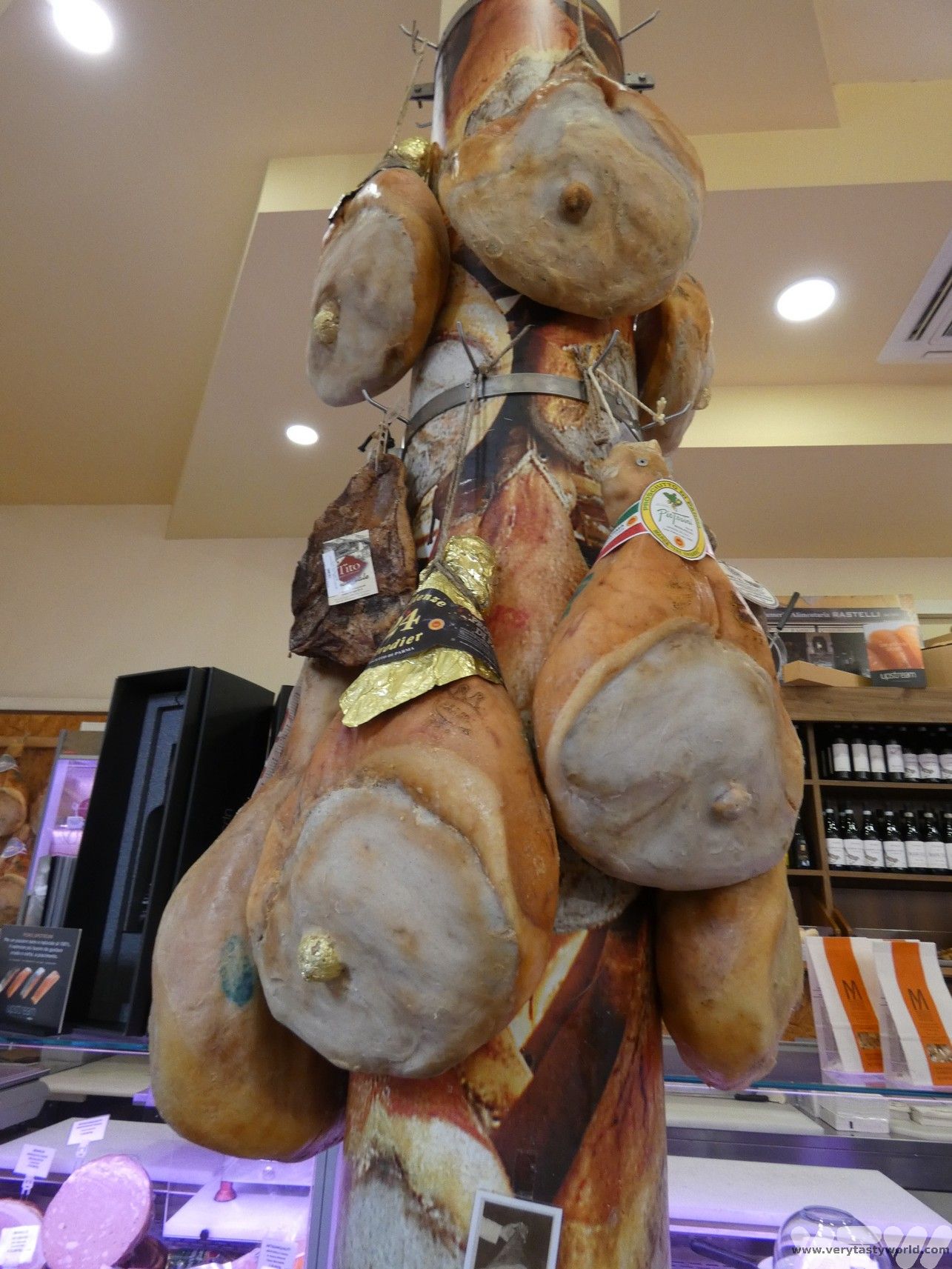
But, we were feeling hungry, so the next stop was Antica Salumeria Alimentaria Rastelli Deli where we learned about Parma ham in the most detailed way imaginable.

Parma Ham

We were served a delightful platter of Parma ham. Starting at the bottom of the photo and moving clockwise, we savoured each cut in order of flavour strength.

The first two cuts were from the posterior leg – Parma ham as we know it. The first had been aged for 24 months and the second cut for 40 months. You can see the difference in the colour – the 24 aged meat is significantly more pink. The 40 month ageing resulted in a much deeper flavour.
Then we moved onto the prized cuts, produced from the most sumptuous section of the thigh meat. Culatta is known as the queen, cured with nutmeg and spices. And, if we have a queen, we also have to have a king: Culatello. It is flavoured with salt, pepper, garlic, cinnamon, cloves and white wine, then cured inside the pig’s bladder for over 14 months. A rare cut, only 70,000 culatello are produced every year, compared with 7 million Parma hams. It has a rich, sweet flavour and a delectable soft texture.
In the middle of the plate was coppa – a neck cut. It is delicately spiced. Lonsardo (to the right in the picture) is loin with a thick layer of lard. The layer of white fat just absolutely melts away in the mouth.
The final sample was salame, spicy and familiar, which uses up the extra meat from the hams, as they are tested for flavour.
Sweet, Sour and Sumptuous
The deli also had another very special treat for us to savour. Modena is yet another foodie town, located close to Parma and is the home of Balsamic vinegar. This most sublime vinegar, sweet and sour, actually originated as a form of medicine. Traditional Balsamic Vinegar of Modena DOP (Protected Designation of Origin) is strictly regulated. It is massively expensive because the production process is so precise and the ageing process takes time. But, oh, it’s worth it!

Balsamic vinegar is made from grapes harvested in the Modena region. The grapes are crushed and their juice, known as must, is cooked slowly, which helps concentrate the sweetness of the grape. The result is a syrup. This is transferred into the first of a number of wooden barrels that decrease in volume, each barrel is made from a different type of wood – cherry, oak, mulberry and chestnut.
Each year, some vinegar is taken from the smallest barrel and that volume is topped up with juice from the next smallest, then that is topped up with vinegar from the third smallest and so on. This process can run for up to 25 years or more! Hence aged balsamic is extremely expensive. We tasted a drop of both 12 year and 25 year vinegars and they were simply sublime. Balsamic doesn’t need to be used in large quantities – mere drops will enhance the flavour of savoury or sweet dishes – although it is so delicious you could probably drink it by the glass!

Then we moved on to Osteria del Teatro in Parma, where the walls are lined with pictures of Verdi and dishes served on vinyl record platemats.
Cheese Is Good, Cheese Is Good
Of course we had to try Parmigiano Reggiano, the famous cheese which also has a Protected Designation of Origin (PDO). According to the official website, the production area for this cheese ‘is restricted to Parma, Reggio Emilia and Modena and in part of Mantua (to the right of the Po River) and Bologna (to the left of the Reno River).’
The cows are only fed on hay and grass from the fields. The minimum time for maturing is 12 months but more flavours develop over a longer time period.

We tasted cheese that had been matured for 24 months and 36 months. The difference in texture and flavour is quite dramatic – the 36 month aged cheese was more crumbly (due to having less moisture) and had a greater depth of flavour.
We also tasted a 24 month aged cheese from a vacche rosse (red cow) breed. The milk from these cows is richer and creamier – considered quite literally to be the crème de la crème (if it’s okay to jumble our languages) of the cheese world. The flavour is beautifully nutty.
Pasta La Vista
And you can’t not have pasta when on a walking tour in Italy. We tasted three types of tortellini: spinach and ricotta, meat in a green spinach pasta, and pumpkin with spices.


Arolini are little pasta parcels served in broth. They are a celebratory food, which take a long time to prepare. A stew is made by cooking beef and pork for several hours until the meat falls apart. Dollops of the meat are placed onto a sheet of pasta, covered with another layer of pasta and cut into cute little parcels using a special cutter.
The broth uses celery, carrots and onion as a base, then bone stock is added. It cooks for hours, with constant attention to remove any froth. The broth is crystal clear and full of flavour – you can taste the time it took to make.
I Scream, You Scream, We All Scream For Ice Cream
And finally, despite being ‘almost’ full to bursting, there’s always room for gelato, right? Located in a former hat shop, Ciacco is one of best gelateria in Italy and has won awards for its sublime products. To be clear, gelato is very different to ice cream. It is made predominantly from milk rather than cream and has a lighter texture which still feels indulgent.

The proprietor is constantly experimenting with new flavours. He only uses natural ingredients. Many of the sorbets are vegan. Importantly, the rule for the best gelato is that it is not put on display but kept in closed tubs, so that it doesn’t oxidise.
We each tried two flavours: one was cream with Brittany butter (decadently rich and very buttery), then hibiscus, pineapple and mint (a refreshing counter to the richness of the butter). The other was creamy pistachio paired with a zingy lime and juniper gelato.

Other Attractions To Visit In Parma
If you can manage to stagger around the city after all that munching, there are plenty of things to see. The opera house regularly offers performances, particularly Verdi operas, so it’s worth checking for any performances during your visit.

Piazza della Pilotta is a large complex containing the Pilotta Palace, a historic palace belonging to the Farnese family. There are many attractions to visit here, including an Archaeological Museum, the National Gallery, the Petitot gallery of Palatina Library, a theatre and the Bodoni Museum.

Across the road, the Glauco Lombardi museum has many exhibits connected with Duchess Marie Louise, who was particularly fond of violets.
Camera di San Paolo has some frescoes by Correggio and the Castello dei Burattini is one of the most extensive collections of puppets.
Final Thoughts
Parma is a delightful city to visit. Its centre is small enough to get around on foot and it has many interesting attractions. Parma is also a delicious city to visit. It’s really not exaggerating to say that many products from the area are iconic. A food tour in Parma is undoubtedly the best way to experience this lovely city and to learn about how so many of its delicacies are produced.
Related Posts You May Enjoy






- Things to Do in Nuuk Greenland – Gateway to the Ice Fjord

- What Food is Florence Best Known For?
- Scrumptious Selections: Smorrebrod Sandwiches
- The Rimini San Marino Bus – How To Get To San Marino

- A Towering Delight – Things To Do In San Marino
- A Scrumptious Food Tour in Parma


Thanks so much for reading. We hope you enjoyed this article. If you’d like to keep up to date with new posts and recipes, please subscribe to our newsletter or follow us on social media – Bluesky, Facebook or Instagram. We always love hearing from you and would be delighted to read your thoughts about this article.




Wow this was so interesting and your post has managed to put Parma onto my bucket list. I would be intrigued to know more about the developments and cirumstances that led to the region becoming such a food paradise. Having been recently on a food tour in Amsterdam, i take it your experience in Italy was similar and your guide shared some historic context for all the delicacies? There’s a great mix of local classics such as the ice cream, cheese and ham and more unusual options such as the carciofa pie. All lovely food that I would want to to try!
Carolin | Solo Travel Story
You warned of not reading this when feeling hungry and I did just that. There tortas sound so delicious, and the Hibiscus, pineapple and mint Gelato/sorbet is exactly the kind of thing I’d try. The fresh pasta, cheese and local balsamic would all make it to my list. The cathedral looks lovely too, and I’d absolutely be booking a Verdi musical experience
What an amazing tour you experienced! I love the variety of specialties and flavours you describe. You really got to enjoy a lot and visit some prime locations, too. I am not a huge fan of ham but I have become enamoured of balsamic vinegar. I’m sure I would need to invest in a big bottle of the best I could find. I had no idea it took so long to create. Of course the gelato is mandatory. The pistachio has me salivating!
The cheese alone would reel me in but those buildings and streets are sublime.
This is my kind of tour! I love balsamic vinegar but had no idea how it was made – it makes sense after reading this just why it’s so pricey! It was interesting about the different cuts of Parma ham too – I don’t eat meat so I’d be making up for missing out on that with extra gelato! Did they have Parma violet flavour? Nice in small doses like the sweets we ate as kids but probably an acquired taste in gelato form!