
Kobe Beef in Kobe – Is It Worth It?
One of the very best things about travelling is tasting the local food. And one local food we had particularly wanted to try on our travels was Kobe beef. But this beef, reputedly amongst the best in the world, is not only known for its deliciousness, it’s also famous for its extremely hefty price tag. We were keen to try this most exclusive of meats when we visited this region in Japan. So is eating Kobe beef in Kobe worth the hype? (With apologies to vegetarians.)
Where is Kobe?
Kobe is located in the Kansai region of Japan (the same region as Kyoto and Osaka) in the southern central area of the main island Honshu, and it is the capital of the Hyōgo Prefecture. It is a port, and one of the cities that opened up to the world in 1868, after Japan’s long period of isolation, and just before the Meiji restoration. It is a lively and cosmopolitan city with plenty of things to see and do.

What Is Kobe Beef?
Kobe beef is one of the world’s most luxurious meats. It’s characterised by the high level of fat content, marbled through the flesh, which means that the meat has both flavour and a sublime melt-in-the-mouth texture.
Like many foods of distinct origin, there are a number of very strict rules to ensure that only cattle bred in a specific region and to the highest standards can bear the name Kobe beef.
The Kobe Beef Marketing and Distribution Promotion Association was established in 1983 with the aim of defining and promoting Kobe beef as a trademark. They were hugely successful – the Kobe beef brand is known worldwide.
The beef is graded using a letter and number system. The letter (A to C) relates to the ratio of meat/fat to the carcass weight of the cow (i.e. the yield) and the numbers (1-5) represent different elements, notably marbling, colour, fat, firmness and texture, 5 being the greatest amount of fat and therefore the tastiest. Remember, fat means flavour! So, A5 beef is the best quality – and the most expensive – that you can get.
Why Is Kobe Beef So Expensive?
The cattle are raised in a way that to give them a stress-free life – the more relaxed the cow, the more tender the meat. It’s a slow process and they are fed a top-quality diet. They are raised naturally over a period of two to three years, which takes time. The cows often have names and usually have a pasture to graze in. Sometimes they are given a brush massage to increase circulation. There are even stories about them drinking beer, but this is a myth.
And, given the success of the branding, you are also paying for the name.
Where to Eat Kobe Beef in Kobe?
We figured that if we were visiting Kobe we really should try Kobe beef while we were there. There are a number of official restaurants in the area close to Sannomiya station. You will see promoters with leaflets wandering the streets and offering deals on meals at specific restaurants.
The Kobe Beef Association has a guide to official restaurants.
We decided to have lunch at Kobe Beef Yazawa Hankyu Sannomiya ten (and not just because Spider-man was clinging precariously to the wall).
The menu was eye-wateringly expensive. Most restaurants in Japan prefer cash to credit cards but the Kobe beef restaurants will happily take cards. We had prepared for a splurge, so closed our eyes, ordered and figured we’d worry about the credit card afterwards – well, within reason!
So What Does Kobe Beef Taste Like?
We wanted to try a variety of dishes, so as to taste the different ways the Kobe beef could be prepared.
You buy the beef by weight and the restaurant has a set of helpful models which indicate quite how much steak you get in each portion. The answer is… that you don’t get much. And 120g of top-grade beef can cost from 9000 to over 29000 Yen ($50-$140) depending on the cut of meat.

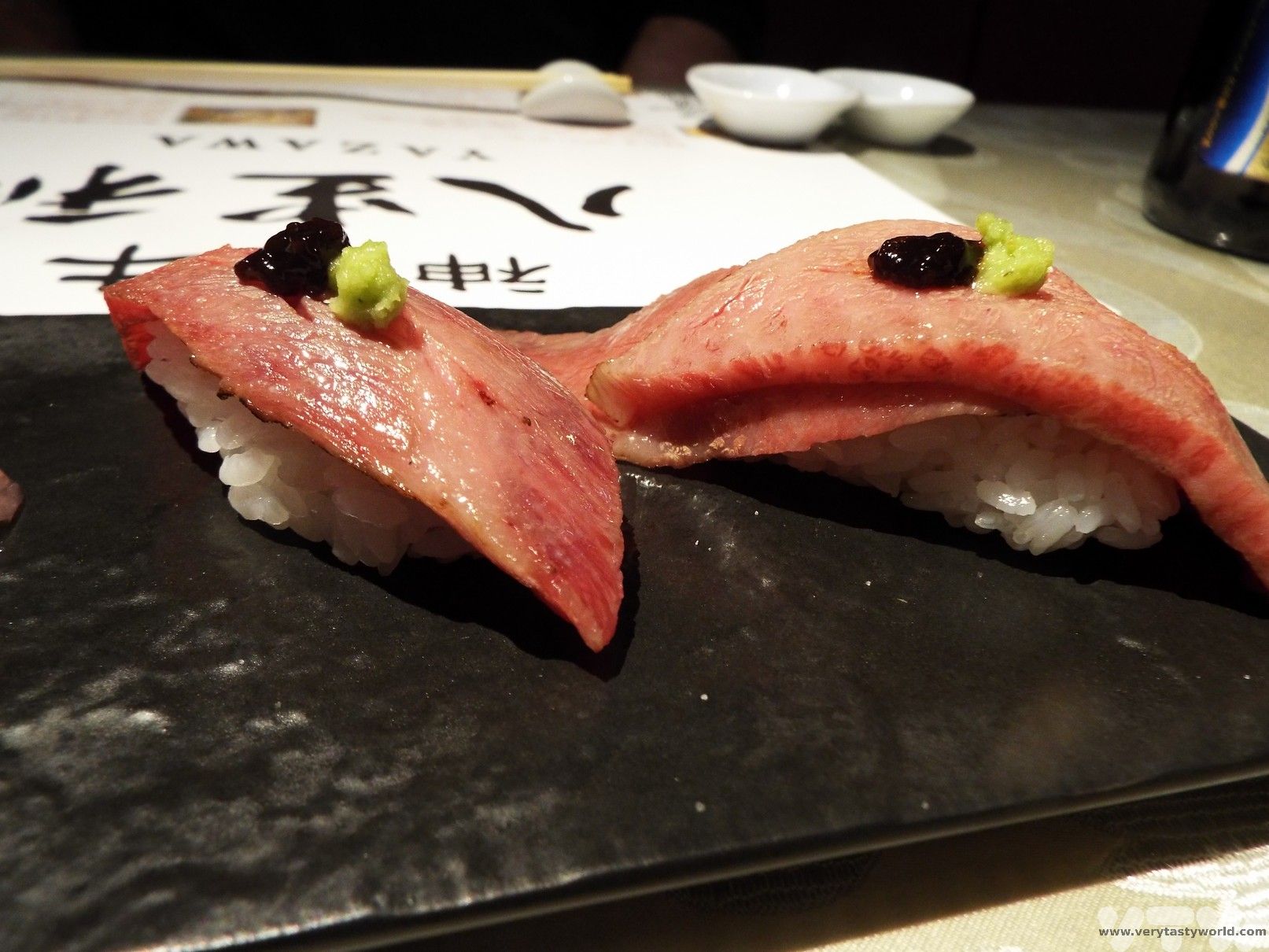
The restaurant offered a set menu and we ordered a couple of extra dishes. The beef ‘sushi’ comprised slices of seared raw beef draped lovingly across seasoned sushi rice with just a dab of condiment.

Then a plate of sliced wagyu, decorated somewhat over-fancifully with a dressing and garnishes.

The set menu comprised beef served steak teppanyaki (cooked on an iron griddle) style accompanied by a number of small dishes – including a beef stew with rice and salad and, of course, ubiquitous miso soup.

We were surprised at the western flavours of the beef stew – carrots and broccoli lying atop some braised beef in a rich gravy just didn’t feel Japanese at all. But the beef had been slow-cooked and was so soft you could cut it with a spoon.
The teppanyaki grilled steaks were served more simply. They had been cooked medium rare. We normally like to eat our steak rare but with Kobe beef you need the fat marbled throughout the flesh to melt into lusciousness, so medium rare is the minimum amount of cooking.


Although the dish was plated with sauces, we wanted to taste the meat without any sauce. Soy sauce or salt are flavour enhancers, and wasabi was served as well. Garlic is a popular accompaniment.
How To Keep Costs Lower
We figured that eating Kobe beef in Kobe would at least cut down on transportation/export costs, so we looked for local restaurants.
If you want to go for the all-out Kobe experience, lunch menus are usually much cheaper than dinner. Some restaurants may even include a service charge at dinner time, which is very unusual for Japan. Service charges and tipping are generally not part of the culture.
Also, some of the prices on the menu may not include sales tax, so bear this in mind when ordering.
An alternative Kobe beef restaurant which is a much cheaper option is the Gyu Tan restaurant. This is beef tongue – but from Kobe cattle. It doesn’t have the melt-in-the-mouth lusciousness of steak because the tongue does not contain fat, but it is a lot cheaper and a very tasty meal in itself. Although as soon as we entered the restaurant, the staff were very keen to make sure that we knew we weren’t going to get a steak. It was fine, we had planned to visit this restaurant anyway.

A gyu tan rice bowl accompanied with a delicious consommé was a reasonable price. The tongue is soft and full of delicate flavour.

Alternatives To Kobe Beef in Japan
With Kobe beef you are paying for the name and the fame. But while Kobe beef is the most famous, other delicious varieties of beef are produced in Japan. Matsusaka Ushi from Mie prefecture and Omi beef from the Shiga prefecture are also highly prized.
In the central region, the Japanese Alps, the lovely mountain town of Takayama is a centre for Hida beef. Hida is derived from kuroge wagyu – black cattle. But the meat still has a high level of fat marbling.


It’s very delicious indeed and a lot cheaper, although it is not a cheap eat, we would still class it as a posh meal. The restaurant Maruaki Hida Restaurant in the centre of town, which is attached to a butchers, offered a BBQ. You are presented with a plate of raw beef and veggies and you cook them on the grill.
The only essential condiment was salt – a sprinkling of salt crystals on top of the meat before cooking. Our friendly server showed us how to do this. Salt is a flavour enhancer – it opens your tastebuds and really maximises the flavour of the meat. We found that the unpretentious atmosphere and grilling the meat ourselves (with help if we had wanted it) was much more to our taste and the meat was flavourful without all the fancy garnishes and sauces.
Other Foodie Fun in Kobe
Steamed Pork Buns in Chinatown
Kobe has a large Chinatown. It is here that you can visit Rosyoki and scoff their stunningly good pork buns which are at the opposite end of the pricing spectrum. You will easily find Rosyoki – there’s usually a long, but relatively fast-moving, queue outside.

Their steamed pork buns are a delight – light and fluffy with a juicy pork and flavoursome spring onion filling.


At just 100 Yen for a bun – and we suggest getting a minimum of three – you can help offset any busted budgets from a Kobe beef splurge.
As you enter the restaurant you can see the buns being made on a grand scale. It’s a swift service – order your required number and then pay.

There are seats inside but they are likely to be occupied. However, the restaurant is located in a nice square which has some areas to sit, so it’s okay to munch outside. (Normally in Japan people don’t eat while walking around or standing in the street, but it was fine here.)

Sake Brewing in the Nada District
Kobe is also famous as a centre for sake brewing. Sake is rice wine brewed by fermenting polished rice. A combination of great quality rice, clean local water and a good climate makes the area ideal for brewing this delicately refined alcoholic drink.

There are a number of breweries located in the Nada district. The Hakutsuru Sake Brewery has an adjoining museum which displays exhibitions that show the sake brewing process.


Sake samples are available so that you can taste the different grades of sake. And of course there’s a shop where you can indulge in some bottles of the local brew.
You can also buy a tub of sake ice-cream. This was definitely worth investigating – and was delicious.
Kobe Herb Garden
Kobe has an extensive herb garden located in the Chuo Ward on the slopes of Mount Rokko. You can take the rope-way up the mountainside and walk through the gardens. The slopes are pretty steep, so it’s best to take the cable car all the way to the farthest station at the top and then walk downhill to the bottom rope-way station.

A visit makes for a pleasant afternoon and you can learn about the different uses of Japanese herbs and vegetables that are used for medicinal and culinary purposes.


So, Is Kobe Beef Worth It?
Honestly? While eating Kobe beef was undoubtedly an experience and a delicious one at that, it is extremely expensive. Part of the problem lies with the marketing – your expectations are inevitably incredibly high.
And, although we very much enjoyed our meal, it wasn’t the sublime gastronomic joy we were hoping for, especially given the cost. If you are looking for a good quality meal that is also good value (although that doesn’t mean cheap), Hida beef would be our preference.
And, as Kobe’s pork buns prove, sometimes you don’t need a large, showy establishment with all the high-end posh-restauranty trimmings to enjoy down-to-earth, simple food that is both cheap and utterly delicious.
Related Posts You May Enjoy

- Just for the Hell of It – The Hells of Beppu

- Five Wonderful Places to Visit From Tokyo

- Amazing Japanese Black Sesame Pudding Recipe

- How To Say Thank You For The Food in Japanese

- What To Know Before Visiting Japan
- Where To See Snow Monkeys In Japan

- Is Kanazawa Worth Visiting?

- RECIPE: How to Make Sushi Ginger – Gari

- Kobe Beef in Kobe – Is It Worth It?


- Great Grinds & Best Brews – Coffee Around The World

- Things to Know Before Visiting South Korea

- Things to Do in Kuching – The Charming Cat City

- The Very Best Kuching Food

- A Splendid Three Days in Singapore Itinerary

- RECIPE: How To Make Dakgalbi


Thanks so much for reading. We hope you enjoyed this article. If you’d like to keep up to date with new posts and recipes, please subscribe to our newsletter or follow us on social media – Bluesky, Facebook or Instagram. We always love hearing from you and would be delighted to read your thoughts about this article.


I loved Kobe beef, and I expected the price tag, but I looked at it as more than food, but the experience of it. I do agree that other cuts of beef would be just as satisfying for a meal with less of the sticker shock haha. It’s such an interesting process to learn about though.
Very glad to hear that you’ve tried Kobe beef and really enjoyed it! You’re right that you have to view the meal as an experience. We did very much enjoy our meal and were expecting the hefty price tag but did feel that it was overpriced.
While you won’t get me trying Kobe beef myself, I can appreciate trying a famous food in the area it’s from. Something I always enjoy when traveling. After all, is there a more authentic experience? I have heard of the huge price tag for Kobe beef and even though I’m not opposed to splashing out for a good meal, that does seem quite steep. But maybe worth trying if you’re there for a meat lover
Good to get an in-person view of the Kobe meat phenomenon, as I heard a lot about it but never tried it – mainly because of the price.
Even though I was travelling around Japan for 3 weeks I never got to try it (I gorged on sushi whenever possible as it is possibly my favourite food).
I also never got to try sake wine, so the info here is also enlightening.
The price of Kobe meat who have been out of my price budget for a meal but I guess I should have tried it on reflection.
Sushi is one of our favourites too! Yes, the price was definitely in splurge territory and it was nice to have tried Kobe beef in Kobe. It was very expensive, but very delicious and we felt worth tasting!
I think it is the experience of eating Kobe beef in Kobe that might make it worth the splurge but I tend to enjoy more humble food — and so does my budget!
I know I would enjoy the sake distillery! I love hot saki and would be keen to try cold saki in ice-cream form!
Lyn | http://www.ramblynjazz.com
You’re right about Kobe beef being about the experience. The pork buns in Kobe definitely proved that humble food can be utterly delish! The sake ice cream was absolutely sublime.
Great food tips and hacks here. I am sure Kobe beef taste divine although I would not be such in a hurry to splurge in the tasting/dining experience just yet when visiting the city of Kobe. I am the type of traveler tempted easily on what’s there to see and do, soak up stories from locals and explore much of the culture. Yet this is Kobe – and one can’t leave the city without tasting its prime offering. Should there be anything left in the budget, I guess sampling the Kobe divinity and saving it the best for last is not such a bad idea #flyingbaguette
Jan – https://flyingbaguette.com/
I first came across Kobe beef during the recent Race Across the World season, and happy to pick this up again now with your post. The tender meat from your pictures does look mouth-watering. I happily pay 50€ for that (I mean over here in Europe a good steak also costs around the 35-40€ mark and it’s a special occasion). I like your tips on reducing potential prices, the street food option or having it for lunch instead of dinner is a great insight. Keep up the good work and delicious research 😀
Carolin | Solo Travel Story
Thank you! We saw the Race Across the World episode too. The meat is absolutely sublime but very expensive, so it was good to research so that we could try to minimise costs.
OK… massaging a cow to activate blood circulation and relax it is another level! No wonder that meat is outrageously expensive. At least for the portuguese standards
However, even though you also pay for the brand, I think it’s a fabulous gastronomic experience to try Kobe beef.
What also caught my eye was the sake… I think I could do it without the steak 😉
Those cows definitely live a good life in order to produce quality meat. You are right that you are paying for the brand. We thought the less famous Hida beef was just as delicious and it was significantly less expensive. And sake is great with anything… or just to sup on its own!