
Places to Visit in Kathmandu, City of Treasures
Kathmandu is the sprawling, bustling capital of Nepal, a place rich with history and culture. The city is not only the gateway to the Himalayas but also to wider Nepal, such as the Chitwan National Park, offering visitors the chance to experience the country’s natural wonders. Although many visitors plan to visit other parts of Nepal, the capital city deserves some of your time. Nepal boasts four world heritage sites, one of which is the Valley of Kathmandu, which itself has seven listed sites. This is our guide for wonderful places to visit in Kathmandu.
Please note that this post contains affiliate links. If you click through and decide to make a purchase we will make a small commission, at no extra cost to you, which will help towards the costs of running this site. Thanks for your support!
A Brief History of Kathmandu
The Malla Dynasty ruled the Kathmandu valley from 1201 to 1779. It was Jayasthiti Malla (1382–1395), who united the Kathmandu Valley. However in 1482, when his grandson, Yaksha Malla died, the valley was divided amongst Yaksha’s sons and became three kingdoms: Bhaktapur, Kathmandu and Lalitpur(Patan). Each of these kingdoms had a Durbar (royal palace) Square. You can visit each of these squares and they contain the most beautiful temples, statues, and other amazing architectural features.
In 1769, Prithvi Nārāyaṇ Shah, a member of the ruling Gurkha principality, conquered each of the kingdoms. They became consolidated and through this process, Shah founded the modern state of Nepal, establishing Kathmandu as its capital.
Sadly many of the Kathmandu Valley’s wonders suffered significant damage during a powerful earthquake in 2015 – renovation works have been undertaken to restore the architecture and monuments.
How To Get To Kathmandu
Most people fly in. International flights are available from all over the world. The airport is around 5km from the city and it can take around 30-45 minutes to get into the city, depending on traffic. You can arrange a private vehicle, use a taxi or an app, or catch a bus.
How To Get Around Kathmandu
You will need transport to reach all the places to visit in Kathmandu. There isn’t a terrific public transport system. You could hire a car with driver, use apps such as Pathao or InDrive, or take a taxi. Taxis are likely not to be metered, so agree a price beforehand. Check with your hotel about the price you should expect to pay. The cheaper option is to use buses which can be a bit more challenging. Ratna Park Bus Stop is the transportation hub.
The traffic is generally awful, so bear that in mind when moving between locations, as travelling time will eat into your day.
Where To Stay in Kathmandu
The city has plenty of accommodation options to suit all budgets. We stayed at the Traditional Comfort Hotel, a mid-range hotel, a little way from the centre, in a quieter district but not too far from the action. It was possible to walk to Durbar Square in about 30 minutes.
Places To Visit in Kathmandu City
Durbar Square
Durbar Square boasts over 50 monuments, some of which date back to the 12th century. It is the most fascinating place to wander around – there are so many features to explore. The key sites include the remains of the Royal Palace

And also the home of a living goddess, at the Kumari Bahal.

But this is a place simply to wander and admire the details of this fantastic historic site.


Boudhanath Stupa
This is the largest stupa in Nepal, and indeed one of the largest in the world, a pilgrimage site for Buddhists, who make a holy circumambulation.

Surrounding the stupa itself are a maze of temples and shops.

Pashupatinath
This Hindu temple, a sacred shrine to Shiva, is the most important in the Kathmandu valley, and one of the most significant on the Indian Subcontinent. It is located on the banks of the Bagmati river, a holy river that has the same properties as the Ganges, the waters offering a deceased person their journey to the afterlife. Hence this is the most important Hindu cremation site in Nepal. All alongside the river you will see funeral pyres as families perform rituals and say goodbye to their loved ones.

In all honesty, while we found the temple to be fascinating, we did feel a little uncomfortable that we were visitors here. We didn’t want to intrude on a family’s grief. We did see shrouded bodies and the lit pyres by the riverside, the smoke rising across the temple grounds and along the river. It is perfectly fine to visit and the site is listed by UNESCO for its history and religious significance, so this was a very personal feeling for us.

Swayambhunath
This beautiful stupa is the most important and sacred of the Buddhist sites in Kathmandu. It’s located a few kilometres from the city.

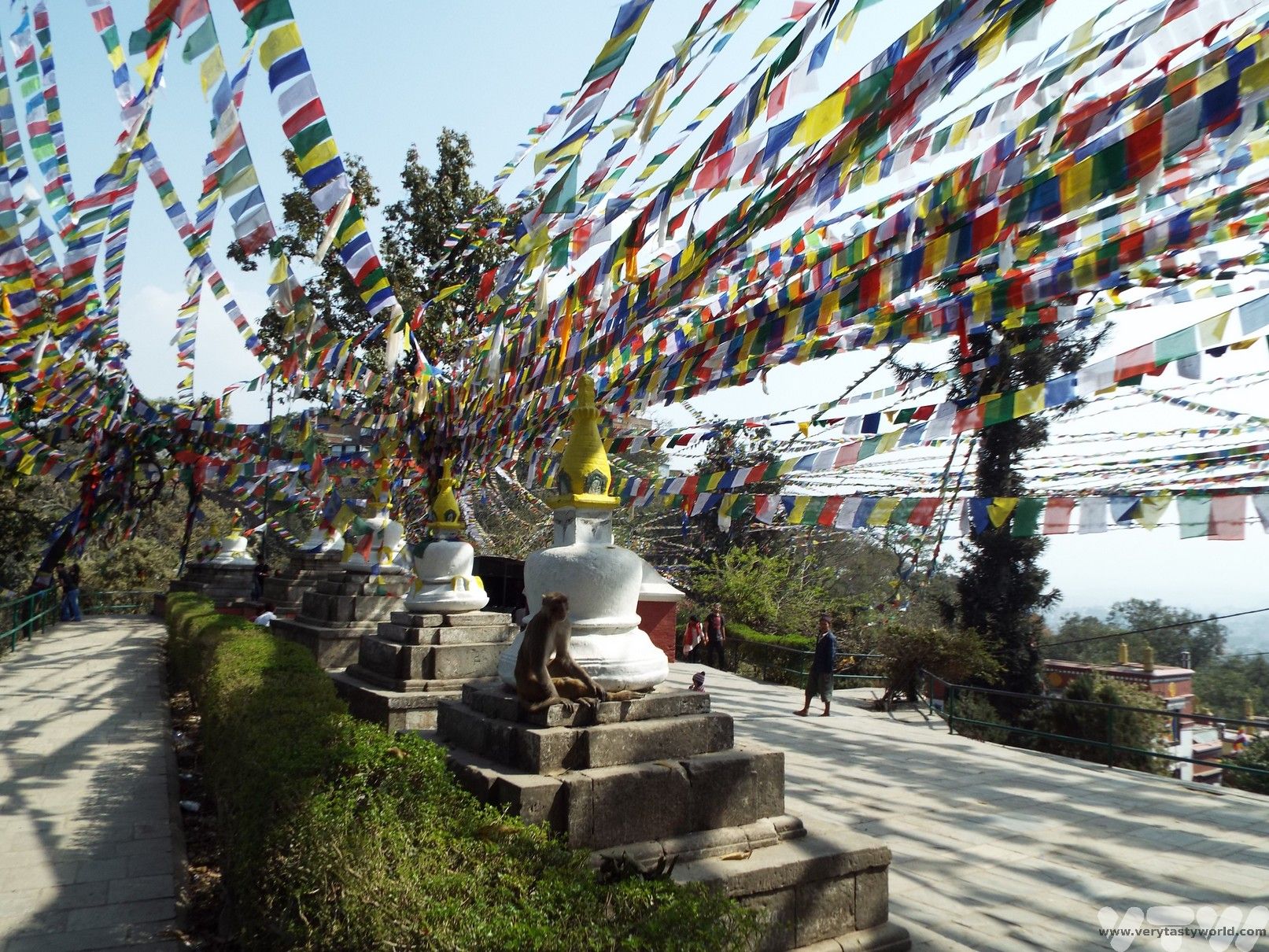
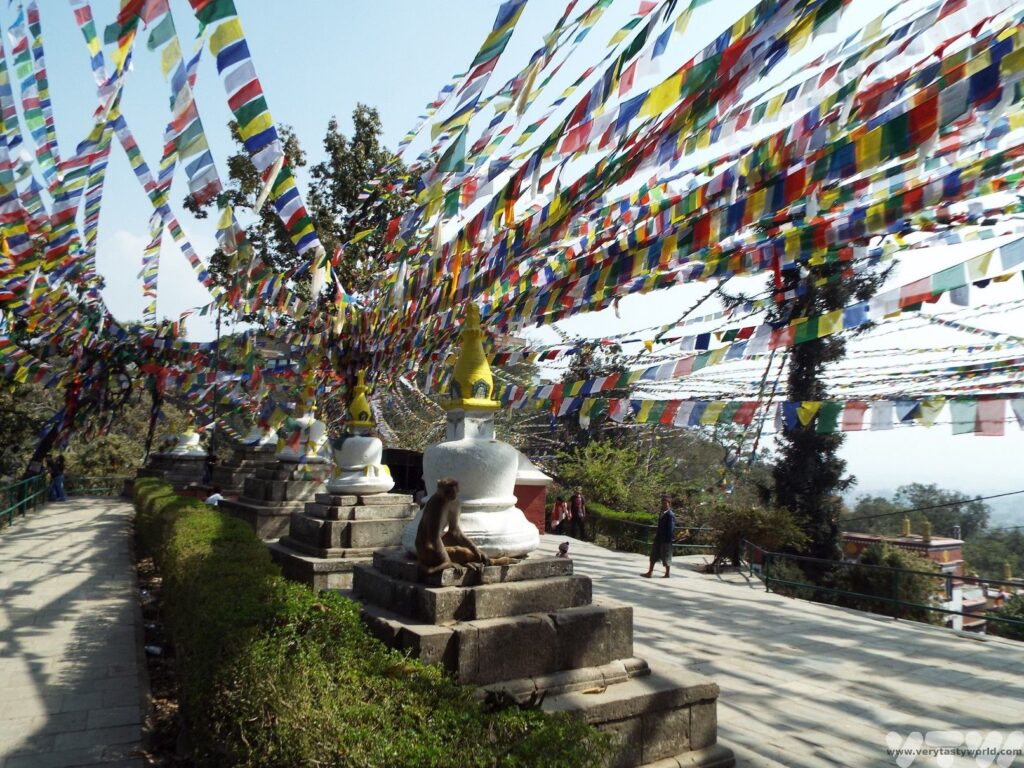
You walk up a path enveloped in prayer flags, accompanied by monkeys – this is known as the monkey temple – to see the stupa.

You also get a magnificent view of the sprawling city below. In the small museum nearby, you can see how much urbanisation has taken place since the 1960s.


Patan
Another UNESCO site, with its own Durbar Square, Patan is another beautiful historic area. It has a long Buddhist heritage. It’s located around 5km from Kathmandu.

Another world heritage site, Patan was believed to be the capital of the mythical Kiranti Dynasty and associated with Ashoka, the Indian emperor who apparently build the city’s stupas around 250BC. It was one of the most important centres for Buddhism in the 7th century and was the most prosperous of the three kingdoms at this time. The Malla kings further developed the city during the 17th century. Most of the amazing architecture that remains dates from this time.

Golden Temple
This delightful golden pagoda, dedicated to Shakyamuni Buddha, was constructed in the 12th century.


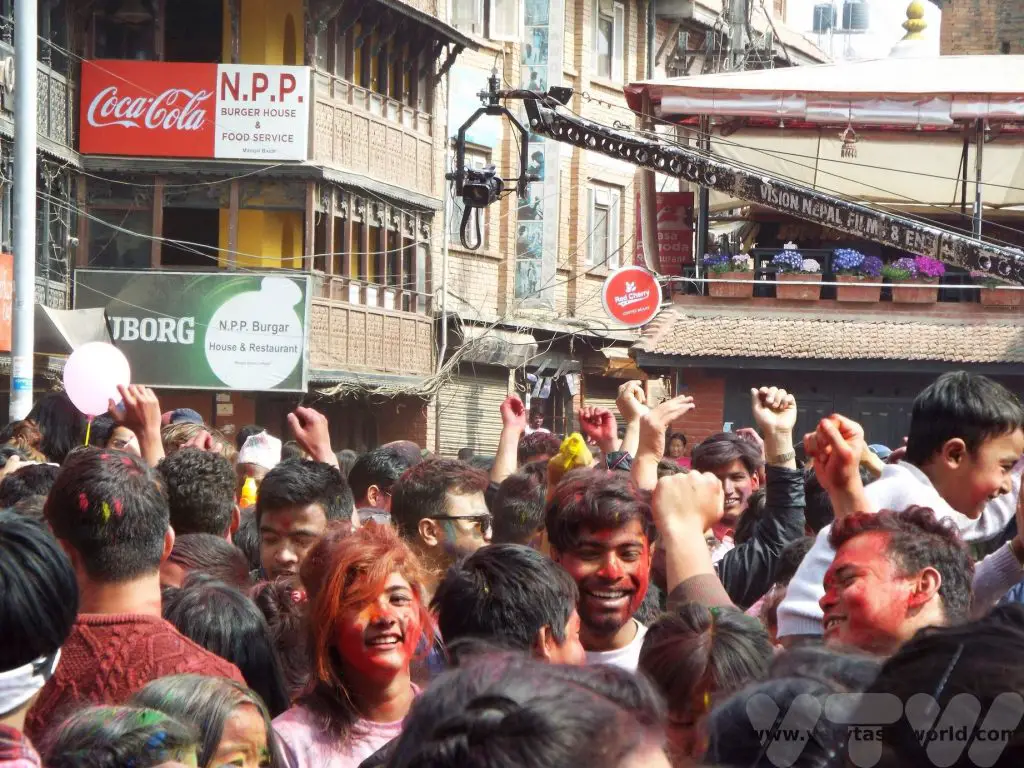
We were lucky to be visiting Kathmandu during the Hindu festival Holi. It was a most joyous occasion – a really friendly and inclusive festival, a celebration of spring and of love. You can read about this wonderful festival of colour, and what to expect if you visit during Holi.

Recommended Overnight Stays Near Kathmandu
Bhaktapur
Although Bhaktapur is only around 13km from central Kathmandu we recommend spending a night here so that you can spend time exploring this exquisite site.
We stayed at the Thagu Chhen Hotel, a boutique hotel with views of Durbar Square. On arrival they asked us to fill in a tick box to select our breakfast options. Instead we asked for a local breakfast – anything would be fine – and they were delighted to cook a delicious brekkie the following morning.
Bhaktapur, another UNESCO site with another Durbar Square, is very, very special. Bhaktapur was established in the 12th century and became the capital of the Kathmandu Valley Kingdoms for over 300 years, from the 14th to the 16th centuries.
The city retains its historic feel. Many of the buildings are centered around the old ponds or tanks which were constructed to store water for drinking, washing and religious ceremonies.

The Fifty-five Window Palace, on the north side of Durbar Square, was once the residence of kings. Although a palace had existed on the site since the 12th century, the current building was built during the reign of King Bhupatindra Malla in 1697.

Nyatopola Temple
This five-storey Hindu temple is the tallest in Nepal. Commissioned by Bhupatindra Malla, and constructed over the course of just six months in the early 18th century, it is over 30m tall.

Bairavanth Temple
Situated on Taumadhi Square, southeast of Durbar Square, this is a three-storey Hindu temple dedicated to Bhairav, the god of both terror and infinite space, and an incarnation of the god Shiva.

The Pujari Math building, was constructed in the 15th century during King Yaksha Malla’s reign. It contains the exquisitely carved wooden Peacock Window, a thing of great beauty and exceptional craftsmanship. The window is known colloquially as the ‘Mona Lisa of Nepal’. Now, normally these sort of comparisons are rubbish, but we reckon the window is actually better than the Mona Lisa.

Bhaktapur is a place where you can spend hours exploring its delightful intricacies. The area is also known as a centre for pottery and other crafts.


Neydo Monastery
Just 25km south of Kathmandu, the Neydo Tashi Choeling Monastery is a Tibetan-style monastery where around 140 monks from India and Nepal live and worship.

The monastery has a guest house where visitors are welcome to stay. Meals and board are provided and the monks are happy for you to join them in their morning and evening ceremonies in main hall.
Just enter the temple quietly and sit on one of the mats provided at the back of the room. Naturally no photos are permitted inside the monastery’s hall when prayers are taking place.

There are lots of walks in the area – it’s possible to visit other local monasteries or the Asura Cave where Guru Rinpoche meditated.
Kathmandu for Foodies
Nepali cuisine is delicious. Momos are the national dish. These are delightfully delicious dumplings, basically a flour and water dough filled with meat, vegetables or cheese. They are usually steamed, often over a bowl of flavourful stock, but can also be pan fried or even deep fried. They are often accompanied by a dipping sauce, something akin to a chutney.
Nepal momos are so popular that you will even see fast food dumpling outlets, especially in Kathmandu. These often offer set meals – you can order via a picture menu just as you would at a burger bar. During our trip we had eaten plateful upon plateful of the delicious little darlings, but it was on our last day – in one of these restaurants – that we realised that we had been eating them all wrong!

Maybe it’s because we’re British, we were trying politely to take a delicate bite of a momo each time we ate one. However, a friendly local, who kindly hid his appalled expression when he saw us daintily eating momos, explained that you should always eat them whole.
The reason? As the momos steam the juices from the filling create a little soup inside the dumpling shell. Bite into part of the momo and the soup drains out – lost forever. Eat the whole momo and the flavour of the broth fills your mouth with soupy deliciousness. Just make sure the momos have cooled down a little before scoffing.
A lot of Nepali cuisine is similar to north Indian cuisine, which is a very good thing.
Thalis are a popular meal in Nepal –a thali is a tray containing bowls with a variety of delicious small dishes on top. There will usually be a variety of curries, including vegetable or non-veg curries, and dhal (lentils) as well as pickles. These are usually served with rice. Vegetarians will not go hungry – the veggie food here is amazing.

Masala omelettes with yoghurt and roti (flat breads) make for an amazing breakfast. The masala omelette contains ingredients such as tomatoes, onions, green chillies and garlic with additional spicy flavours. Definitely a superior omelette.

Local specialities from the Newar community of the Kathmandu valley include chatamari which are like savoury pancakes. Rice flour, spices and eggs are used to make a batter then the chatamari is then fried on top of a flat grill. You can have meaty or veggie toppings. Our was a minced meat and onion topping with fried egg and was utterly yummy.

Soybeans roasted in Nepali spices are spicy and crunchy – the perfect snack to drink with local beer.
Final Thoughts
Kathmandu may be the entrance to the wonderful country of Nepal but it deserves a few days of your time. The history is fascinating but the real joy of the city and surrounds lies with the detail and intricacy of the architecture and monuments. Kathmandu is truly a place of treasures.
Related Posts You May Enjoy



- A Marvellous 7 Day Tamil Nadu Itinerary

- RECIPE: Vegetable Biryani Tamil Nadu Style
- RECIPE: Biryani Raita Recipe
- The Leh to Manali Highway
- Places to Visit in Munnar, Kerala
- Kumarakom Houseboats on the Kerala Backwaters

- Great Grinds & Best Brews – Coffee Around The World

- Things to Know Before Visiting South Korea

- Things to Do in Kuching – The Charming Cat City

- The Very Best Kuching Food

- A Splendid Three Days in Singapore Itinerary

- RECIPE: How To Make Dakgalbi


Thanks so much for reading. We hope you enjoyed this article. If you’d like to keep up to date with new posts and recipes, please subscribe to our newsletter or follow us on social media – Bluesky, Facebook or Instagram. We always love hearing from you and would be delighted to read your thoughts about this article.




What a lovely post on Kathmandu. A place I’ve heard of but no little about. Loved reading about the history. Interesting to see that the family divisions led to the creation of the royal squares. Great detail displayed in the post and thanks for sharing.
Kathmandu looks a fantastic place to visit – I hadn’t realised there was so much to see there as most other posts I’ve read about Nepal just mention it in passing en route to other parts of the country. Your posts always make me hungry too – I’d be happy eating momos all day long!! It’s good to know that vegetarians are well catered for too – that masala omelette looks delicious.
Lovely! I always wanted to go and see Kathmandu. I think it will be something of a spice market in overdrive and each temple visit is a step closer to the divine. I love that you highlighted the food part too..because I think Kathmandu is also a place for the palate to explore and experience #𝐟𝐥𝐲𝐢𝐧𝐠𝐛𝐚𝐠𝐮𝐞𝐭𝐭𝐞🥖🪽
Kathmandu looks like a fabulous place to explore. I always enjoy visiting Hindu temples for the variety of statues and architecture. Holi is a fabulous and fun festival and I hope to be in Nepal/India to participate in it one day. The dumplings look delicious and I know I would indulge daily. I appreciate the tip to eat them whole, as I would do the same as you did with delicate bites!
I appreciated how you talked about some parts of visiting a place where it might not always feel comfortable, and that just because you CAN doesn’t mean you necessarily SHOULD. What a beautiful place, one I’d love to visit, especially to see some of those magnificent temples with such intricate detailing. I’d absolutely want to stay at the monastery – I did this once in China and it was such a unique experience. I also never knew about eating momos whole, I’ll have to amend my eating habits next time I have them, I love a good dumpling!
I’ve picked up new information and random facts. Favourite ons from your post are learning about the Pashupatinath. I would have felt the same. Fascinated but also slightly out of place to show respect to the griefing families. An experience which I can feel is quite enriching as it evokes so many conflicting emotions and must stay long after the visit.
Second one about how to eat the Momos dumplings properly. They remind me of pocket coffee, a chocolate praline filled with espresso coffee. Some snacks just need to be eaten in their entirety otherwise you create a mess for yourself. Very sweet that a local gave you some guidance.
The new blog layout looks fire!
Carolin | Solo Travel Story
Durbar Square and Swayambhunath are incredible to experience.
I remember monkeys being all over that place when we visited in 2013.
Nice breakdown, Mitch.
Magical city that really does feel like time travel.
I know nothing about Nepal, so this post was super interesting. I totally get the feeling of not feeling like you should be somewhere, when loved ones are grieving-it’s hard isn’t it. I loved this post, the photos are stunning