

Great British Regional Breakfasts – A Guide
Let’s be honest, in these cholesterol-conscious times, traditional British breakfasts aren’t the most healthy way to start your day. But (don’t tell anyone) an occasional good old-fashioned fry-up is kinda delicious. British breakfasts are the sort of naughty treat that you’d be unlikely to cook at home these days – they’re a bit of an effort – but something to enjoy once in a while, especially when someone else cooks it for you. Did you know that each region of the UK has variations on a typical breakfast? Here’s our guide to great British regional breakfasts.

History of the British Breakfast
In Britain, we have a saying, “Eat breakfast like a king, lunch like a prince, and dinner like a pauper.” But, as with many things, the great British breakfast started out as food for the rich – the gentry were able to show off their massive wealth by offering fabulous feasts using only the finest produce. The ingredients we know today became popular during the Victorian and Edwardian eras (19th and early 20th centuries) but a full breakfast was really only for the wealthy.
However, as industry developed and the price of food decreased, working people began to be able to afford the ingredients and the breakfast as we know it became a popular way to start the day. Indeed, around half of Brits in the would start their day with bacon and eggs in the mid-20th century. Fried food became less popular over time as people became more concerned about their health. Additionally, changes in working practices meant that cooking a full meal early in the morning, when the entire household was due to go to work, wasn’t very practical. So these days, a full breakfast is usually reserved for a special occasion.
If you’re travelling in the UK and having a breakfast at a hotel or café, you will usually be offered a choice – the Full English/Scottish/Welsh/Irish Breakfast. It’s perfectly acceptable to pick and choose which bits of the breakfast you want to eat – just ask for your favourite ingredients. Or you could do what we do and ask for a full breakfast and then swap the bits you don’t like with your dining companion.
The best British breakfasts should always use quality ingredients. There is nothing worse than terrible sausages, filled with rusk and offal, watery bacon, and a sad fried egg swimming in a pool of grease. Sadly, some establishments, in an attempt to cut costs, do not use great ingredients.
Traditional British Breakfast – The Essentials
There are all sorts of variations on the British brekkie but all of them will have sausages, bacon (usually back bacon) and eggs. The eggs are often fried but may be served scrambled or poached, and you will usually get to choose how you would like your eggs to be cooked.
There will also be some bread – either toast, which is usually served separately, or fried bread which is served with the plate of food. Fried bread comprises a slice of (usually) white bread fried in the fat of the bacon and sausages. It has absolutely no nutritional value whatsoever, but it tastes good. We reckon it’s okay to eat fried bread once every 10 years or so!

These are the fundamentals. And then there are traditional embellishments:
Black pudding may well be offered. It is a blood sausage which doesn’t sound very appetising but when made well it is delicious. Mushrooms and tomatoes are common accompaniments to acknowledge the presence of vegetables in the brekkie. Traditionally the ingredients are fried in a large frying pan, but more health-conscious chefs may use the grill or oven these days.
Modern Additions to the Breakfast
Veggie breakfasts are increasingly popular and you can get very decent veggie sausages although, to be honest, we’ve yet to discover facon (fake bacon) that has achieved real culinary excellence.
Hash brown – grated potato that is formed into a patty and fried – is a relatively new addition and it’s usually not that great. It is really an American ingredient, that has somehow ended up on the British breakfast plate. A far better embellishment is bubble and squeak – mashed potato and cabbage mixed together and fried – it is named for the sound that it makes as it cooks.
Baked beans are something that many people outside the UK struggle with. Baked beans are haricot beans in a tomato-based sauce. Many breakfast eaters prefer not to have the ingredients drowning in tomato sauce (after all, you don’t want your runny egg yolk to be diluted with bean sauce if you’re dipping your toast in it) so the classier presentation is a separate dish of beans. If it’s all piled onto the plate you may have to build a sausage dam (left) to keep the bean juice out of the way of other ingredients. Some presentations go a little bit posh and pile all the ingredients on top of each other (right), which is a little bit pretentious for a British brekkie.

Sauces are an essential addition to the breakfast. The most popular are tomato ketchup and brown sauce, a mildly spicy, fruity sauce that is rich and tangy in flavour.
A cup of tea or coffee is the standard drink to accompany your breakfast. Although we know some establishments that offer a beer to make the whole experience even naughtier!
The Full English Breakfast
The full English will contain all the traditional ingredients – bacon, egg, sausage, mushrooms, tomato, beans and black pudding.
One of the best things about a full English is the sausage. There are different regional sausages. The most popular are:
Cumberland – this originated in Cumbria and is an unusually long sausage, coiled up into a ring. You’d generally be served a portion of the sausage. These are pork sausages, flavoured with herbs and spices, with a healthy dose of black pepper.
Lincolnshire – hailing from the county of Lincolnshire, this is another pork sausage and is flavoured with sage, salt and pepper. Unlike the Cumberland, these can be long, short, fat or thin.


If you offered bubble and squeak – do take it. It’s not often on the menu but it’s really nice.
We are incredibly lucky that our home city has a gourmet chef who makes his own sausages and smokes the bacon. He cooks both the beans and the bubble & squeak from scratch, and even produces his own tangy brown sauce. His breakfasts are a real treat.
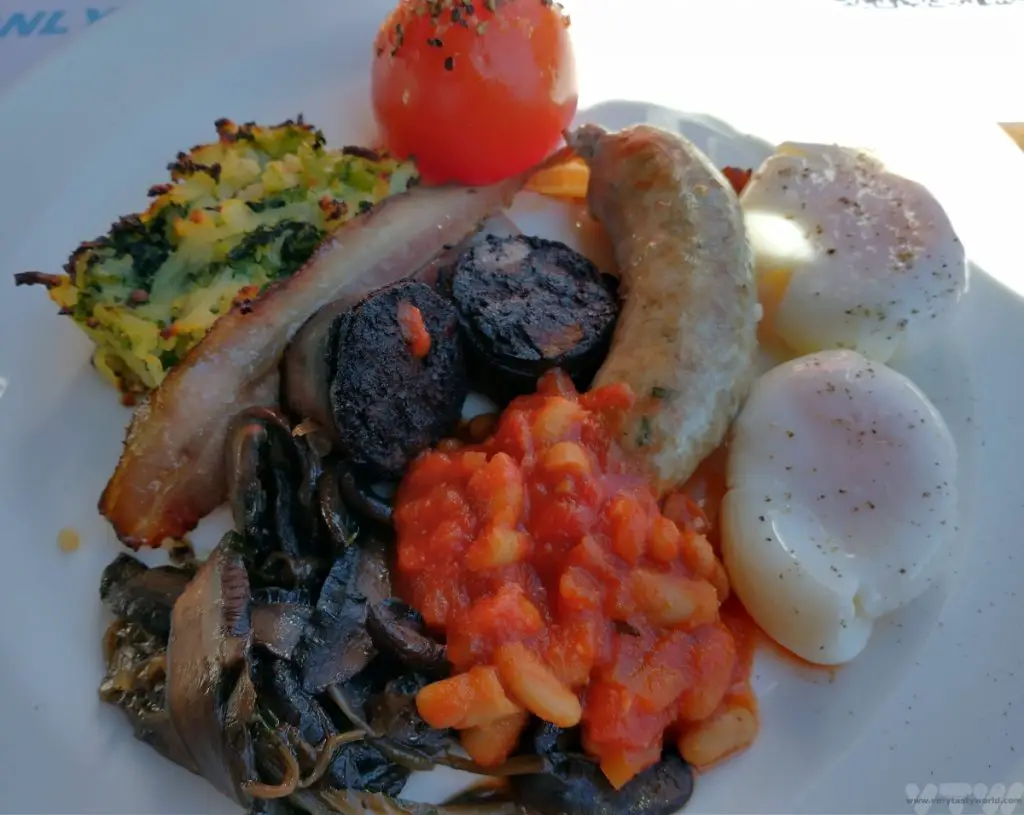
The Full Scottish Breakfast
The Scottish breakfast is a beautiful thing. Scotland is home to an amazing variety of quality ingredients.
The lorne sausage is a flat, square sausage made from minced meat, usually pork or beef, and rusk, with added herbs and spices. It’s has quite a different flavour to a standard sausage and is really delicious.

Potato scones, also known as tattie scones, are like potato flatbreads and they beat a hash brown any day. They’re made from seasoned mashed potato and flour. They are tasty and filling and definitely not greasy, which is often a problem with hash browns.

You may also enjoy some haggis, which is another ingredient that you don’t really want to think about but is surprisingly good.
The Full Irish Breakfast
When we were talking to our friend who hails from Northern Ireland we asked whether this region has a typical national dish. Her answer was the ‘Ulster Fry’.
A couple of ingredients that we really enjoyed during our trip to Northern Ireland was black pudding and white pudding. Historically both of these are puddings that were designed to make full use of a slaughtered animal to ensure that none of it is wasted.

Black pudding is a blood sausage which also includes a cereal (usually oatmeal) and fat. Herbs and spices add flavouring. White pudding does not contain blood, and is an oatmeal pudding that uses suet and offal, usually pork.
The Full Welsh Breakfast
Now a Welsh breakfast is an altogether different thing. It has the basic components of course, but a traditional Welsh breakfast also incorporates the flavours of the sea. Alongside the sausage, bacon and egg, you will also find laverbread and cockles.

Laverbread is a seaweed paste. It is delicious spread on top of toast or bread. Laverbread is made from laver seaweed (littoral alga, the same seaweed that Japanese nori is made from), foraged from the coastline and boiled for several hours until it forms a puree. It is sometimes known as Welsh caviar.

The cockles are another traditional ingredient. Bivalve shellfish, they are juicy and slightly salty, and surprisingly delicious.

A traditional Welsh breakfast is quite difficult to find in some hotels because they have decided over the years to stop offering it as many visitors are not keen on trying it. Well, it’s their loss because it’s really, really good! You are more likely to find a full Welsh breakfast in South Wales. You can buy cockles and laverbread at Swansea market if you’d like to make your own Welsh brekkie.
Other Traditional British Regional Breakfasts
Porridge is a traditional Scottish breakfast – oats cooked in water or milk and served hot in a bowl. It’s hearty, filling and warming, and will absolutely set you up for the day. Purists will say that porridge should be made with water and only flavoured with salt. But porridge is often made with milk and sugar. The very best is made using cream and flavoured with jam or honey, which makes the dish luxurious and decidedly decadent.

Kippers are popular in the north of England and Scotland. These are herring that have been ‘kippered’, that is, split in two and butterflied open, cleaned, salted, and cold smoked. Cold smoking involves smoking the kippers at a low temperature, which doesn’t cook them but imparts a lovely flavour. The kippers will then be grilled for breakfast. These are oily fish and considered to be really good for you – packed with Omega 3. There are a lot of very thin bones to contend with, which means that many people aren’t so keen, which is a shame, because they taste delicious.


Have you tried a British breakfast? Which of the regional breakfasts would you most like to try? Let us know in the comments.
Related Posts You May Enjoy






- The Rimini San Marino Bus – How To Get To San Marino

- A Towering Delight – Things To Do In San Marino

- A Scrumptious Food Tour in Parma

- A Fabulous Four Days in Florence

- Coastlines, Castles & Crab – Things to Do on Guernsey

- What To Do in Tromsø in Winter – Arctic Activities


Thanks so much for reading. We hope you enjoyed this article. If you’d like to keep up to date with new posts and recipes, please subscribe to our newsletter or follow us on social media – Bluesky, Facebook or Instagram. We always love hearing from you and would be delighted to read your thoughts about this article.





As a child, my dad would cook us a full fry-up at least once a month. I now know it’s an artery-clogging feast but as a special treat, I can’t feel guilty! Breakfast after a holiday meal always includes bubble and squeak, an absolute favourite of mine. (My children never learned to appreciate it — all the more for me!) I don’t think I’ve ever had a Welsh breakfast but I will look for it on my next visit.
You’ve made me very hungry, and homesick. I still make a good “full English” here in Canada although I can’t get anyone to support adding beans. Oh well, more for me. I’m from Cumbria so we often have Cumberland sausage where I’m from, but being close to Scotland there’s also potato scones which are honestly my favorite part.
I had no idea there were so many regional takes on the full English breakfast! I’m not a huge fan of English breakfasts as I don’t eat THAT heavy of a meal first thing, but I would like to try the Welsh variation – laverbread sounds interesting (I’ll skip the cockles though haha)
Oh the British Breakfast, a classic of British cuisine but it’s not for me unfortunately. Maybe I can get on board with the beans in tomato sauce, but the rest? It’s a bit too heavy and greasy for my likening and I need either something sweet or nutty to get me going in the morning. Porridge is a great British breakfast alternative and luckily the scene is changing so there are many nice brunch restaurants and cafes about.
Carolin | Solo Travel Story
It’s interesting how close the traditional British breakfast is to how I would eat breakfast as an American, especially with the bacon, eggs and sausage. Not a big fan of the baked beans and tomatoes though! It’s interesting how all of the different variations are similar in many ways, with sausage being a central ingredient. Ireland’s breakfast is interesting with the infusion of ham. As for hash browns, all I can say is, it’s best when the potatoes are shredded, seasoned and grilled – not sure how it’s done there but it sounds like it’s cooked differently. I would definitely try the different sausages, especially the Lincolnshire and the Cumberland sausages.